Here are the answers to the "What Do They Have in Common?" quiz:
1. Keith Crissman, Larry Jerome, Dick Davis? - automobile dealers
2. Hale's, Stapp's, Zimmerman's, Burr's? - shoe stores
3. Deaton's, Byers', Potere's? - gas stations
4. Milton Weaver, Maurice Watson, Nina Martin? - real estate offices
5. Alward, Johnson, Plassey, Young? - groceries
6. Oberg's, Avon Theater, National Bank of Rochester, Varsity Shoppe? - all were located, at various times, at 435 S. Main
7. Lucille's, Carpenter's, Buzzell's? - clothing stores
8. Brooks, Reading, Terry? - dentists
Wednesday, February 9, 2011


Saturday, February 5, 2011
What Do They Have in Common?
Here's another little quiz for those of you who remember Rochester of the 1950s and 1960s. For each numbered item, decide what all the named elements have in common with one another. Answers will be posted here on Wednesday, February 9.
What do these have in common?
1. Keith Crissman, Larry Jerome, Dick Davis?
2. Hale's, Stapp's, Zimmerman's, Burr's?
3. Deaton's, Byers', Potere's?
4. Milton Weaver, Maurice Watson, Nina Martin?
5. Alward, Johnson, Plassey, Young?
6. Oberg's, Avon Theater, National Bank of Rochester, Varsity Shoppe?
7. Lucille's, Carpenter's, Buzzell's?
8. Brooks, Reading, Terry?
Tuesday, February 1, 2011
This Month in Rochester History
 Fifty years ago this month, in February of 1961, Rochester residents were saying goodbye to a familiar business on Main Street. Verne Sutton, who had operated Sutton's Market on the southwest corner of Third and Main (where Mind, Body & Spirits is today), announced his retirement in the February 23, 1961 edition of the Rochester Clarion.
Sutton told the Clarion that some of his original customers who had started out with him when he opened the market in 1934 were still with him after 27 years, and he would miss them. The day of the small grocery store was fading fast, however, as more chain supermarkets came on the scene, and Sutton's was one of the last to leave the downtown business district. Verne Sutton sold the building and liquidated his grocery inventory, and soon after a gift shop called The Dants opened in the former Sutton's location.
This view of Sutton's Market is from the collection of Marjorie and the late Walter Dernier.
Saturday, January 29, 2011
Main Street Stories: DeBaene Building
 The building at 419-423 S. Main Street was completed in late 1926 by local businessman Camille J. DeBaene on a lot that for half a century before had been the location of the offices of Doctors Jesse and Jerry Wilson. A native of Belgium who came to the U.S. with his family as a child, DeBaene settled in Rochester after his marriage in 1905. In 1926, the Clarion announced that a new, one story stone and brick building was going up on the Wilson site and would house the A&P grocery store when complete. The DeBaene building was part of a mini building boom on Main Street that was sparked in anticipation of the construction of the South Hill bridge, scheduled for the summer of 1927.
Over the years, the DeBaene building has house two or three businesses at a time in its three sections. Among the tenants have been the A&P, DeBaene Lunch Room, DeBaene Tax Service, The Thimble Shop, Martin's Men's Wear, Cap' Tele-Tec TV Service, Avon Printing, Avon Recreation, Shepard's Bar, Birmingham Camera, Boulevard Bridal, and most recently, Mr. B's Food and Spirits, and the Spy Shop.
The DeBaene building celebrates its 85th birthday in 2011.
This 1940s postcard view of the DeBaene building is from the collection of Rod and Susan Wilson.
Saturday, January 22, 2011
Subdivision Stories: Woodward Heights
 There are several places in Rochester named in honor of pioneer farmer and businessman Lysander Woodward, and one of them is the Woodward Heights subdivision located west of North Main Street between Woodward Street and the northern city limits. The property on which the subdivision was laid out was formerly part of the farm of Lysander Woodward, which totaled nearly 400 acres and included land on both sides of Main Street.
In 1920, Woodward's daughter, Emma, and her husband, noted Detroit architect John Scott, sold a part of the Woodward estate to the Rochester Development Company. Local business leaders William Clark Chapman and Milton H. Haselswerdt were the officers of the development company, and William J. Fisher, a partner in the Fisher Brothers architecture and engineering firm of Pontiac, was the surveyor who laid out the streets.
One of the street names shown on this plat of the Woodward Heights subdivision has changed; Sugar Avenue, so named for the Detroit Sugar Company factory built upon in 1899, was renamed Woodward Street by the village council in 1927. Also notable among the subdivision's street names is Scott Street (highlighted in red on the plat), a very short street - now an alley, really - between Glendale and Ferndale, presumably named for proprietors John and Emma Woodward Scott.
When the lots in Woodward Heights were offered for sale, lot #1 was purchased by Rochester businessman A.R. Dillman, and lot #2 was purchased by Milton H. Haselswerdt. The fine homes these two men built upon those lots still stand today along North Main.
The Woodward Heights subdivision celebrates its 91st birthday this summer.
Saturday, January 15, 2011
At Home in Rochester: The George Flumerfelt Residence
 The home on the southwest corner of Walnut and Fourth streets was built in the summer of 1895 by George M. Flumerfelt (sometimes also spelled Flummerfelt). Flumerfelt was born in Oakland Township in 1838, one of nine children of pioneer Oakland farmers William and Esther Flumerfelt. After seeking his fortune in an extensive tour of the western United States as a youth, George Flumerfelt returned to the Rochester area where he farmed a large tract of land. He also invested in the local banks, and served as officer and director of several local businesses. He was also active politically and served as village clerk, village councilman, and member of the school board.
Flumerfelt's first wife, the former Rebecca Cummins, died in 1890 and two years later he married Clara E. Crissman. The couple built their new home in Rochester at 339 Walnut Street, on the corner opposite Fourth Street from the Baptist church. The Rochester Era of May 24, 1895 reprinted this announcement from the Pontiac Gazette:
Fisher Bros. have completed plans and specifications for a very fine modern frame house for G.M. Flummerfelt, of Rochester. The structure will be 56x40 feet, two stories and an attic, with octagon corner tower.The Fisher Brothers, Charles and William, had just launched their architecture and engineering firm in Pontiac in 1895. The company went on to great success and designed many buildings that were prominent in Pontiac in their day. They also designed the granite fountain donated to the village of Rochester by Samuel Harris in 1917.
The basement will be divided into furnace and coal rooms, vegetable cellar, etc., with cement floors, with outside and inside entrances.
The ground floor will have a parlor, hall, sitting, bed and bath rooms, kitchen and summer kitchen, pantry, dumb waiter, etc. The hall and front stair case will be of panel work; the sitting room with have mantel, grate and tiled hearth, and the whole first floor is to be finished in oak; and the dining room floor to be of inlaid beech and oak. A colonial porch will extend across two sides, divided by a corner tower.
The second floor is to be divided into four chambers and store room, with closets throughout, all to be finished in Georgia pine, and have balconies over porches. Attic unfinished.
The roof will be hipped, with gables and dormers and of slate and with galvanized iron crestings and finials. All windows to be of double thick American glass and doors of double polished plate and art glass.
This will be the finest residence in the village, and reflect credit upon Mr. Flummerfelt, as well as its young designers.
George Flumerfelt died in 1917, and in 1929 his residence became the location of the Alanson C. Hobart Funeral Home. After William R. Potere bought out Hobart in 1950, he made several additions to the house to accommodate the needs of his growing funeral and ambulance business, but the features of the original house are still clearly visible today. John and Mary Modetz purchased the funeral home from Potere in 1986 and continue to operate it in the former George Flumerfelt residence.
The George M. Flumerfelt residence will celebrate its 116th birthday in 2011.
Saturday, January 8, 2011
Vanished Rochester: Old St. Andrew
 St. Andrew Roman Catholic Church is one of Rochester's largest congregations today, and has most certainly not "vanished," but the building that served as its home for nearly half a century has, indeed, disappeared from Rochester's landscape.
The congregation had celebrated its first mass in Rochester in 1912, and two years later purchased a lot on the southwest corner of Walnut and Third streets. In 1923-24, construction of a new church facility was begun with the excavation of the basement. The congregation used the enclosed basement for several years and completed the construction of the church building on a pay-as-you-go basis over the next several years.
As Rochester experienced robust population growth in the post-World War II era, so did the St. Andrew congregation, and the church on Walnut Street became increasingly inadequate for its needs. A new site in the northeast corner of town was purchased and the parish began using its new facility there in 1969, placing the Walnut Street property on the market.
The old church was first optioned by a developer who envisioned placing boutique businesses in the building, but those plans fell through and the City of Rochester purchased the site with the intention of adding much-needed parking spots for the downtown business district. The planned demolition of old St. Andrew sparked a major public outcry, and an effort to stop it was led by a local architect. More than 500 petition signatures were gathered during a two-day demonstration on Main Street, complete with a parade and band music, and letters of support were gathered from local industrial leaders. The Oakland County Pioneer and Historical Society weighed in as well, calling the impending destruction of old St. Andrew an "irreparable loss." On the other side of the argument, city council members were firmly convinced that their duty lay in solving downtown's critical parking shortage, and after some last-minute legal wrangling, gave the order for the bulldozers to roll. On July 24, 1972, old St. Andrew passed into the pages of vanished Rochester.
Saturday, January 1, 2011
This Month in Rochester History
Happy New Year to everyone and welcome to the third year of Remembering Rochester!
This year, I've decided to make a small change in my "This Month in Rochester History" posts. On the first day of each month in 2011, I'll look back fifty years in Rochester's history to find out what was making big news in town during the corresponding month in 1961. Those readers who were in town at that time are encouraged to post comments with their own memories of these events.
So, here we go - in January 1961, this is the Rochester Clarion story that caught my eye:
Happy 50th birthday, Friends of RHPL!
This year, I've decided to make a small change in my "This Month in Rochester History" posts. On the first day of each month in 2011, I'll look back fifty years in Rochester's history to find out what was making big news in town during the corresponding month in 1961. Those readers who were in town at that time are encouraged to post comments with their own memories of these events.
So, here we go - in January 1961, this is the Rochester Clarion story that caught my eye:
New Group Offers Help to LibraryToday, this half-century-old organization is known as the Friends of the Rochester Hills Public Library, and it continues to support the library's programs and services with grants made possible through fund-raising efforts such as used book sales and the Friends' Library Store.
A group of volunteers moved this week to ease the strain on facilities of the Avon Township Public Library.
The newly-formed "Friends of the Library" will hold its first general meeting at 8 p.m. Friday in the library, 210 W. University Drive.
Persons attending the meeting will be able to become charter members of the group.
Happy 50th birthday, Friends of RHPL!
Friday, December 24, 2010
Rochester Elevator Listed on National Register of Historic Places
 The Griggs Brothers/Rochester Elevator Company Grain Elevator, located at the corner of Water St. and East University Drive in Rochester, has just been listed on the National Register of Historic Places. Brothers Charles K. and Albert G. Griggs built the elevator in 1880 on what was then the Detroit & Bay City Railroad line. At the time, the opening of the elevator was important news for the Rochester area, because it connected local farmers with state and national grain and produce markets and saved them from having to haul their crops to Detroit to sell them. The elevator was a center of commerce for Rochester and contributed to the economic success of the farmers in the surrounding townships.
Charles K. Griggs operated the elevator for about 20 years, then sold it to a business partner, E.S. Letts. In 1909, the building was enlarged at both ends to form the structure that we know today, and the name was changed to the Rochester Elevator Company. The business passed through several other owners before the Smith family took over more than half a century ago. Although it no longer ships grain to market, the Rochester Elevator is the oldest continuously operating business within the city limits of Rochester, and has been housed in the same structure for 130 years. Earlier this year, the Rochester Avon Historical Society nominated the Rochester Elevator for the National Register of Historic Places, and that designation has just been awarded by the Office of the Keeper of the National Register at the National Park Service. Congratulations, Rochester Elevator, on a well-deserved honor!
Saturday, December 18, 2010
At Home in Rochester: The Lloyd G. Satterlee Residence
 The cement block home on the southwest corner of North Main and Griggs streets was built by Lloyd Garrison Satterlee, an inventor and entrepreneur, in 1905. Satterlee had invented a process for manufacturing cement roofing tiles and designed the house to showcase his product. He began construction in the fall of 1905, and in the spring of 1906, the Rochester Era reported on his progress:
L.G. Satterlee is busy finishing his house in the Albertson addition, the cement walls of which were up last fall. He proposes a roof of cement shingles of his own patent and manufacture -- both house and barn -- which will furnish a practical test of their utility in all respects. The residence is a model of convenience and is to be finished in the best possible manner.The house must have attracted positive attention, because Satterlee and other local investors including E.S. Letts, William C. Chapman and George A. Hammond formed the Twentieth Century Cement Tile Roofing Company in Rochester in 1907 to manufacture and sell Satterlee's invention. The company lasted but a few years, and Satterlee moved on from Rochester, eventually settling in Santa Cruz, California.
Eventually, houses on North Main Street transitioned from residential to business use, and the Satterlee residence became the home of Norman Hastings' Culligan Soft Water Service. Today, it is occupied by law offices.
The L.G. Satterlee house is 105 years old this year.
The accompanying photograph shows the Satterlee residence as it looked in 1907.
Saturday, December 11, 2010
Subdivision Stories: Elmdale
 The Elmdale subdivision at the southwest corner of Crooks & Auburn roads was platted in June 1925 on part of the farm lands of Harry J. and Kate L. Davis Serrell. The Serrells were dairy farmers, and owned a large tract of land in sections 32 and 33 of the Township of Avon, lying immediately south of Auburn Road.
When they platted their subdivision, Harry and Kate Serrell named the streets lying within it for their three children: Grant J. Serrell (1897-1956), Donald J. Serrell (1900-1981) and Alice D. Serrell (1906-1997). Grant St. still exists within the subdivision today, but in 1950 the Township of Avon renamed a number of streets at the suggestion of the county road commission. At that time, Alice St. was renamed Alsdorf, and Donald St. was renamed Donley.
The Elmdale subdivision is 85 years old this year.
Wednesday, December 1, 2010
This Month in Rochester History
 Anyone who regularly travels on M-59 has doubtless enjoyed the recent completion of the road widening through Rochester Hills which has had the highway under construction for the past year and a half. It's an appropriate time to look back thirty-eight years to December 1, 1972, when the public dedication and ribbon cutting ceremonies took place for the original M-59 expressway between Pontiac and Utica.
On the drawing boards since the early 1960s, the road construction got underway in May 1971 and was completed at a cost of $9 million (not including the property purchases for right-of-way). In contrast, the recent widening project begun last summer to add a third lane between Crooks and Ryan cost $50 million.
At the same time that the Utica to Pontiac expressway was under construction, Macomb County officials were planning to extend it eastward all the way to I-94. At that time, Hall Road still ran through mostly undeveloped property, and the route was feasible. However, the plan never moved forward and retail and housing development along Hall Road ruled out the project after a few years.
This photo, taken by Macomb Daily photographer Robert Sassanella, shows local officials huddling against the December cold for the 1972 ribbon cutting ceremony. Shown from left are: Ron Poli, Kirby Holmes, Gail McCauley, George Nickson, Carol Harris, Thomas Guastello and Donald Bemis. (Photo used with permission from the Macomb Daily).
Saturday, November 27, 2010
Bygone Business: Bill's Barn
 Sixty-four years ago, the newspapers carried the announcement of the grand opening of a new entertainment venue in the Rochester area, and the place was known as "Bill's Barn." Strictly speaking, Bill's Barn is in Shelby Township, since it is located on the east side of Dequindre Road, just north of Auburn, but I'm including its story in this blog because it is right across the township line and was frequently by many Rochester people in its heyday.
The proprietor and manager of Bill's Barn was William Schroeder, who opened the dance hall on July 26, 1946, with Rochester's own Hollis Hinkel and his orchestra providing the music. The inaugural dance was a benefit for the Brooklands Fire Association, and regular public dances began the following night. The hall became a popular spot for square dance enthusiasts and teens following contemporary dance as well.
One year after the grand opening, the Brooklands Exchange Club announced that it would sponsor a youth center at Bill's Barn, serving teens from Shelby and Avon Townships, and the building became a focal point of teen social events throughout the following decade.
By the time I was a teen, Bill's Barn had been converted to its current use, the home of the local Disabled American Veterans chapter and the location of a weekly flea market. I imagine that there are plenty of "Bill's Barn" stories out there from its dance hall days - how about it, readers?
Saturday, November 20, 2010
At Home in Rochester: The Burton McCafferty Residence
 Not long after the interurban line came to Rochester at the turn of the twentieth century, so did a Macomb County man named Burton "Bert" McCafferty. McCafferty had been born nearby in Bruce Township in 1867, and was in business in Marine City before he relocated to Rochester to operate a saloon and cigar stand on Main Street.
Business must have been good, because in the summer of 1906, the Pontiac Press Gazette reported that Bert McCafferty was building a new house in Rochester. On October 23, 1906, the Press Gazette said, "Bert McCafferty and family are moving into their fine new residence on West Fourth Street." Although it was not mentioned in the newspaper account, local tradition says that like the C.G. Griffey house, the McCafferty house is one of several buildings in the area constructed with brick reclaimed from the demolition of the Detroit Sugar Company mill, which happened during 1906.
The McCafferty family stayed only a few years in their new house on West Fourth. By 1920, Bert McCafferty had moved his business interests to Wayne County. The Dobat family lived in the house after the McCaffertys, and by 1930, it was the residence of local businessman and owner of the Rochester Elevator, Lewis Cass Crissman.
Today, the McCafferty house is a beautifully restored private residence, and it celebrates its 104th birthday this year.
This photo, from a 1907 publication promoting Rochester, shows the McCafferty residence as it looked just after it was built.
Saturday, November 13, 2010
Vanished Rochester: Danish Old People's Home
 The stately old home that stood atop the bluff at the corner of Walton and Brewster roads was known as the Danish Old People's Home from 1949 to 1973. The property on which the house stood was owned for the last half of the 19th century by Oliver Hazard Perry Griggs and his wife Lovina Kelly Griggs, who migrated to Avon Township from Wyoming County, New York in 1865. Griggs farmed the land and reared his children there, but moved to the village of Rochester in his later years. The farm then passed into the hands of his son, Charles K. Griggs, owner and operator of the Rochester Elevator. C.K. Griggs continued to operate the farm but did not reside there - he had a handsome home in the village of Rochester as well.
In January 1915, C.K. Griggs sold the farm at Walton and Brewster, consisting at that time of 210 acres, to Pontiac farmer Arthur M. Butler for the sum of $21,000. Butler lived on the farm until the death of his wife, then sold it in October 1939 to Herbert M. Bray, an executive with the Ajax Steel & Forge Company of Detroit. Herbert Bray died in 1945 and in May 1948, his widow, Violet, sold the estate which the Brays had called "Diane Acres" to the Detroit Lodge of the Danish Brotherhood in America for use as a retirement home for Danish Americans. Extensive additions and renovations were planned to the house to make it suitable for its new purpose.
In February 1949 the Danish Brotherhood celebrated the dedication of the Danish Old People's Home in Avon Township. In 1962, a memorial garden and fountain were added to the property in honor of all Danish immigrants to America who had located in the Detroit area. The fountain was the work of renowned sculptor Marshall Fredericks, featured a bronze swan in flight, and was entitled "Nordic Swan and Ugly Duckling." Count Knuth-Winterfeldt, at the time the Royal Danish Ambassador to the United States, visited the Danish Old People's Home to formally dedicate the garden and fountain.
In early 1973, the Danish Brotherhood announced the closing of the Danish Old People's Home because the society did not have the funds to complete an expensive array of necessary repairs and upgrades to the property. The 20 residents at the home were moved to other facilities and the home closed on April 30 of that year. Soon thereafter, Lutheran Social Services of Michigan began plans for a modern senior living community at the location, and the old house was razed when construction of the new facility began.
Danish Village was opened to residents in 1980. The memorial garden and fountain with the Marshall Fredericks sculpture were retained and are still a prominent feature of the property today.
This postcard view of the Danish Old People's Home is from the collection of Rod and Susan Wilson.
Saturday, November 6, 2010
Subdivision Stories: Spring Hill
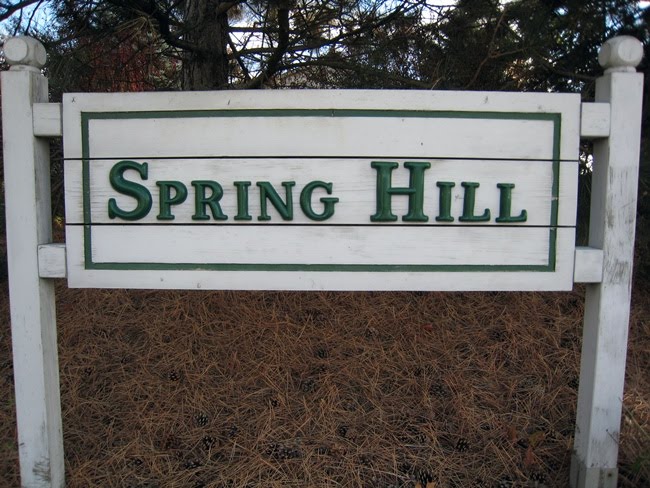 The Spring Hill subdivisions near the southeast corner of Walton and Adams roads stand on land that was owned by the Ross family for most of the nineteenth century. The property was originally purchased from the federal government in 1825 by Needham Hemingway, a settler who came to Oakland County from Monroe County, New York and built a grist mill in Oakland Township around which the settlement of Goodison would eventually form. By 1857, John Ross, a local builder who had migrated to Michigan from Northampton County, Pennsylvania, owned the land. It later passed to John Ross's sons, George S. Ross and David H. Ross.
We have some information about the inhabitants of the area before Needham Hemingway bought the land, however. This item published in the Rochester Era on November 3, 1899, tells us:
D.H. Ross of Southwest Avon brought to The Era office last Friday a rare collection of Indian arrowheads which he picked up on his farm. In early days an Indian trail ran through the farm and the redmen were in the habit of camping near by on Renshaw's lake [the lake referred to here was on the Jacob Miller farm just to the south of the Ross property and is also known as Miller's Lake on most maps]. Mr. Ross says that he has gathered more than a bushel of arrowheads and other Indian relics, but had given the most of them away. The arrowheads are made of a flinty stone, which looks very much like that which abounds in the Lake Superior region.
The Ross land was eventually purchased by Pontiac real estate investor Edward M. Stout, and in the spring of 1955, his widow, Grace, platted the first Spring Hill subdivision on it. Subsequent Spring Hill subdivisions were platted later in 1955, in 1957 and 1959, and were developed by the Howard T. Keating real estate firm, which offered new houses in the $25-30,000 range. Today there are 323 lots in the combined Spring Hill subdivisions. The original Spring Hill subdivision celebrates its 55th birthday in 2010.
Monday, November 1, 2010
This Month in Rochester History
 One hundred and twenty years ago this month, Rochester residents were invited to the grand opening of a brand new entertainment venue - the Rochester Opera House. Located on the second floor of Charles A. Burr's new building on the southeast corner of Fourth and Main streets, the Opera House became the "in" location for all sorts of public gatherings. At the time, Rochester did not yet have a movie theater, and the school building had no auditorium. The churches were large enough to seat an audience for certain kinds of events, but they weren't exactly appropriate venues for boxing matches, minstrel shows, vaudeville acts, and the like. With the opening of the Opera House, Rochester had an opportunity to house traveling acts of all kinds.
The Opera House held its grand opening on Friday, November 7, 1890. The event was a dinner at the Sidney House (later Detroit Hotel) at Third & Main, followed by a dance in the Opera House featuring music by Finney's Orchestra from Detroit. (At the time, Finney's Orchestra, led by violinist Theodore Finney, was considered to be one of the premiere society musical ensembles in the area, and later went on to make quite a name for itself when ragtime became popular.)
Over the years, the Rochester Opera House played host to a wide variety of events, including amateur and touring theatricals, boxing matches, concerts, dances, lectures, civic meetings and high school commencement ceremonies, but I have never seen an advertisement for an actual opera at that location.
In 1909, hotel operator James W. Smith began offering motion picture exhibitions in one of his buildings, and in 1914, the Idle Hour Theater opened to the public. The new high school building added a state-of-the-art auditorium a few years after that, and these new venues dwarfed the capacity of the Opera House, causing it to gradually fall out of favor as a gathering place by the early 1920s.
The newspaper ad shown here promoted a 1914 event at the Rochester Opera House. A couple of the contestants in these matches were local men. Do you recognize any names?
Wednesday, October 27, 2010
Bygone Business: Michigan Motor Car Manufacturing

On February 25, 1910, the citizens of Rochester saw this large advertisement in the Rochester Era, informing them that their little village would soon join the ranks of Detroit and Pontiac as home to an automobile factory. The Michigan Motor Car Manufacturing Company, with offices in Detroit, announced that it would establish a factory here and build its 6-cylinder roadster, dubbed the "Michigan Six," in Rochester. The ad described the Michigan Six this way:
The Michigan Six is a light, smooth running car, six cylinders ("continuous power"), powerful, long wheel base, 123 inches; large wheels, tires 10x4 inches front and rear; multiple disc clutch, selective transmission running in oil; three point suspension of unit power plant; magneto; advanced system of carbaretion [sic], exclusive. For material and workmanship it is the best.Residents of Rochester, according to the ad, would be given the agent's discount when purchasing a "built in Rochester" Michigan Six.
There was just one little problem. According to the Standard Catalog of American Cars, 1805-1942 (Krause Publications, 1996), this is what happened:
[the company] showed its first car at the Detroit Automobile Show in January 1910. It was a 30 hp six-cylinder roadster on a 123-inch wheelbase, with a $1,550 price tag. In February the company announced that it would relocate in a new factory in Rochester -- the former Ayres gasoline engine works -- and production for 1910 would be 500 cars. All this was window dressing. In March Motor World revealed that the factory in Rochester was a small shed, and the Michigan Motor Car Manufacturing Company, Ltd., was a stock-selling scheme. This one was found out more quickly than most others. The first Michigan Six was also the last.Michigan Motor Car was just one of scores of auto manufacturing companies that came and went quickly during the infancy of the auto industry. In the first seven months of 1910, there were no less than 49 new motor car manufacturing concerns registered in the state of Michigan.
Friday, October 22, 2010
Vanished Rochester: Pavilion Hotel
 Rochester's first hotel was built by Elnathan Wilcox about 1839 - less that fifteen years after the village was platted - on the southwest corner of Third and Main Streets, and was originally known as the Pavilion Hotel. A two-story frame building and barn that sheltered the weary traveler and his horse, the Pavilion passed through several owners during its existence and had its name changed several times. In 1856, Harvey Bennett was the proprietor, and by 1877 Wilson Fenner was running the hotel as the Fenner House. A couple of years later, Oscar Comstock took over, and the hotel was known as the Comstock House.
On April 15, 1880, Rochester suffered a devastating fire that completely destroyed the Pavilion Hotel, then known as the Comstock House, and the Universalist Church. The Rochester Era described the chaotic scene:
At about twenty minutes before 12 last (Thursday) night fire was discovered bursting thru the roof of the Comstock House in this village, and before a general alarm could be sounded the entire roof of the building was enveloped in flames and all hope of saving the house was out of the question. Barnes' paper-mill whistle was sounded loud and long and the church bells rung out arousing the sleepers who rushed to the scene of the conflagration, unable, however, to render any assistance other than help remove some of the household effects.The Comstock House and the church were total losses. The Universalist Society began almost immediately to rebuild, erecting a brick building that still stands today on Walnut St. The Comstock House was not rebuilt, and the lot sat vacant, to the chagrin of the townspeople, for nearly nine years before a new brick house, named the Sidney House, was opened in 1889. The name of the Sidney House was eventually changed to the Detroit Hotel, and on February 22, 1927, that building met the same fate as had it predecessor.
...
The wind at the time was blowing briskly from the northeast filling the air with fire and cinders, which were wafted towards the Universalist Church and other buildings in that direction. Soon came the cry that the church was on fire which proved too true and notwithstanding people were on the roof with pails of water the upper portion was soon all ablaze and past saving.
Friday, October 15, 2010
At Home in Rochester: Congregational Parsonage
 The beautiful Gothic revival residence on the northwest corner of Pine and Third streets was built in the summer of 1878 by the First Congregational Church of Rochester, for use as its parsonage. Church officials had been working to acquire a parsonage site for several years, but were unable to raise the necessary funds to secure property. They finally made progress when Lysander Woodward volunteered to buy and hold the desired lots while the congregation raised the balance of funds needed.
Finally, on April 17, 1878, ground was broken on the long-awaited parsonage. Lysander Woodward's son-in-law, noted architect John Scott of Detroit, designed the home, and Miles King of Rochester was the builder. The contracted amount for the construction was $1,100.00, plus $54.00 for a cistern and fence.
The Rochester Era described the new residence this way:
This parsonage is without exception the finest and most complete model of architectural beauty and elegance to be found in the township of Avon, and reflects abundant credit upon not only its architect, Mr. John Scott of Detroit, a son-in-law of Lysander Woodward, but also upon its builder, Mr. Miles King of this village, who of course was assisted by several first class workmen among whom were Mr. Hammond and Mr. Fenner, resident mechanics. The style of architecture is properly Gothic, although there may be perhaps some deviations from the strict letter of the original in a few of the details. The exterior of the structure is finely ornamental, and in a manner that exhibits much architectural taste and refinement, everything being in strict keeping with the rules governing the style. Some of the designs in the ornamentation are really unique and so skillfully executed as to excite our admiration. The bay-window, for instance, which beautifies the east front of the main structure is a model of its kind, being very elaborately finished and trimmed - not in an 'overdone' manner - but with exquisite taste and neatness, the workmanship harmonizing, as before intimated, with every tracery of the designs.The new parsonage welcomed the pastor, the Rev. Mr. Brown, in January of 1879, and was used by the church until 1917, when the congregation decided that the house was too large for its purpose and voted to build a new parsonage immediately behind the church. The 1878 parsonage was authorized to be sold into private hands and has remained a private residence ever since.
Today, the 132-year-old house has been lovingly restored, and the Gothic Revival elements so that the Era editor found so endearing may still be admired. It is significant in our local history not only for its relationship to the oldest Congregational church in Michigan, but also because it is the work of John Scott, the architect of the 1902 Wayne County Building and the 84 East Ferry house, both of which are listed on the National Register of Historic Places. Next time you pass the corner of Third and Pine, take a moment to admire this local historical treasure.
This postcard photo shows the Congregational church parsonage as it appeared about 1915.
Friday, October 8, 2010
Bygone Business: Purdy's Drug Store
 Those who lived in Rochester from the mid-1940s to the early 1960s will remember Purdy's Drug Store, located at 321 S. Main St., where the Janet Varner shop is today. Henry L. Purdy and his wife Elizabeth, who were originally from Columbiaville, Michigan, first owned a drug store in Clawson for nine years before buying the Rochester store from druggist W.E. Ford in the summer of 1944. Henry Purdy was very active in community affairs here during the eighteen years that he was a Main St. merchant; he served on the Board of Education and participated in Avon Players, Kiwanis Club and the Chamber of Commerce.
The Purdys sold the store to druggist Tom Hunter, who took over in January 1963. Coincidentally, back when Henry Purdy was in business in Clawson, a competing drug store across the street there was operated by Tom Hunter's father.
Henry and Elizabeth Purdy retired to their home near
 Columbiaville, in St. Clair County.
This advertisement for Purdy's Drug Store appeared in a 1947 issue of Lens Magazine, and is provided courtesy of Rod and Susan Wilson. The castor oil bottle is also from the Wilsons' collection.
Friday, October 1, 2010
This Month in Rochester History
 This month marks the 77th anniversary of the death of one of Rochester's most prominent early twentieth-century businessmen, James Wilson Smith. J.W. Smith was the proprietor of the Hotel St. James, located on the southwest corner of Main and University Drive (formerly Fifth St.), where the Bean and Leaf cafe is situated today.
Smith was born in Dublin, Ireland in 1847, and as a child immigrated with his family to Ontario. As a young man he ventured on to Michigan, where he worked as a wagon driver for a hotel in Pontiac. He worked in the hotel business for a couple of decades before deciding to try his hand at farming in Avon Township. His farm was a failure, and when the old Lambertson House in Rochester became available in 1890, James W. Smith bought it, refurbished it, and ran a highly successful hotel business there until his death on October 2, 1933.
The Hotel St. James was a hub of downtown activity for decades, and "Jim" Smith was an unabashed Rochester booster. He served as a member of the village council for six years and was always active in village affairs.
Local newspapers frequently noted that James W. Smith bore a striking resemblence to President William Howard Taft, and made a special point of being present to greet President Taft on each of his visits to Michigan.
James W. Smith died in his private apartment in the Hotel St. James at the age of 86 and was buried in Mount Avon Cemetery.
Saturday, September 25, 2010
Rochester's Oldest Business
 Have you visited Rochester's oldest business lately? If you do, be sure to extend a "Happy Birthday" wish to the Rochester Elevator, celebrating the 130th anniversary of its founding this year. In the fall of 1880, brothers Charles K. and Albert G. Griggs opened their new grain elevator on the corner of Water St. and Fifth (now University Drive) and began shipping their first crops on the Detroit and Bay City Railroad line. The elevator has been in continuous operation at the same location ever since, making it the oldest business within the city limits of Rochester. Several owners have run the elevator during that span of time - although fewer than you would probably imagine - and the current owner has been at the helm for over half a century.
The Rochester Elevator is a downtown icon - one cannot help but notice the colorful advertising on the side of the building facing University Drive - and it has seen a lot of Rochester's history pass before it during the last century and a third. Think about it - Chester A. Arthur was President of the United States when the elevator first opened its doors! Happy Birthday, Rochester Elevator!
Saturday, September 18, 2010
Train Wreck at Rochester
 Do you remember when the trains rumbled through Rochester? Growing up just a couple of blocks from the tracks, I was often rocked to sleep at night by the hypnotic clickety-clack of the cars passing through the north side of town. Rochester's last line was abandoned in 1998, and now we have peaceful recreational trails running along the former railroad beds.
In earlier days, however, it wasn't so peaceful with up to forty trains a day running through the village on both lines. Rochester also had its fair share of railroad-related accidents, as this story from the Pontiac Daily Press of September 21, 1906 tells us:
Engine Turns Turtle In Lake at Rochester
Brakes Fail to Work at Right Time and Locomotive Jumps Track
Rochester, Sept. 21 -- An unusual accident occurred near the depot here on the Michigan Central railroad yesterday morning. A heavily loaded stock train, southbound, was switching and being made up on the side track leaving the main track clear for the northbound passenger, which was about due. The rails were in such a slippery condition, owing to the slight rainfall in the morning, that the engineer of the freight found it difficult to manage the heavy train on the sharp grade at that place, and whistled for the brakes to be applied. For some inexplainable reason the brakes did not have the desired effect, and the engine with reversed levers was forced down the grade by the weight of the loaded cars. Although the engine was one of the largest on this line, being built with three huge drive wheels on each side, it was impossible to check the speed acquired by the cars while descending. Near the bottom of the grade, however, the brakes must have suddenly taken hold, as the huge engine suddenly jumped the track and turned turtle, plunging down a three foot embankment and into Chapman Lake, where it lay hissing in about four feet of water.
A peculiar feature of the accident is that beside the engine and tender, none of the other cars were thrown from the track, and also that the main line was not in the least obstructed to traffic. Both the engineer and fireman had barely time to jump clear of the falling locomotive as it became uncoupled from the train proper and pitched from the rails, careening dangerously over the steep embankment, before turning over to the lake where it lies upside down, the short smoke stack dug into the mud.
Need Large Wreckers
A wrecking crew was at once rushed to the spot, but found that the heavy engine, which weighs in the neighborhood of 40,000, would require more than an ordinary wrecking train carries to be pulled from its present watery resting place. The accident occurred yesterday morning about 11 a.m. and up to this noon, the huge engine was still in Chapman Lake, where it probably will be until some sort of a contrivance can be rigged up to lift it from the lake. The engine, except for a few minor damages, can probably be easily repaired, as the soft bottom of the lake served to break the force of the plunge.
Quite a spectacle that must have made for the citizens of Rochester, 104 years ago this week!
This 1908 plat map of the east side of the village shows how close the railroad line ran to the edge of Chapman Lake.
Saturday, September 11, 2010
Vanished Rochester: Woodward School
 In the 1920s, the children of the village of Rochester were served by the school district known as Avon Township District #5. This school district operated two buildings along Wilcox St. between Fourth and Fifth (now University Drive), where all students from primary grades through high school were housed. But by the mid-1920s, however, enrollment pressure on the district was so great that plans were made to build another elementary school at the north end of the village. The site for the new school was on the street known as Sugar Avenue (which was renamed Woodward Street by the village council in 1927). Both the street and the school building thereon were named in honor of Rochester's pioneer farmer and politician, Lysander Woodward, whose farm had, in earlier days, encompassed the property where the new school was planned.
Ground was broken for Woodward School in April of 1926, with the firm of J.M. Olson of Pontiac doing the construction. The contract price for the two-room school was $21,345, not including plumbing, heating, and fixtures. The little school was ready to receive its first students by the end of that summer. Enrollment continued its upward trend, and Woodward School was expanded in 1928 to add two more rooms. Further additions were made in 1958 and 1967, but by then Woodward School was only one of several elementary schools in the now-consolidated (and mu
 ch larger) Rochester Community School District.
Rapid subdivision development in Avon Township (now Rochester Hills) during the 1970s and early 1980s caused school district officials to re-evaluate the placement of the elementary schools, and they determined that Woodward School was no longer needed and ordered the building closed. The last day for students at Woodward was June 17, 1983, as the fifty-sixth class poured out of the doors for the final time. The following year, the Older Persons Commission (OPC) was located in the school, and occupied the building until October 2003, when a new OPC facility was opened. A few months later, Woodward School passed into the pages of Vanished Rochester as it fell to the wrecking ball to make room for a housing development.
The photos in this post are from the collection of Rod and Susan Wilson. They show the school as it looked just prior to and during demolition.
Sunday, September 5, 2010
At Home in Rochester: The Clinton G. Griffey Residence
 The stately home at 444 West University Drive (formerly Fifth St.) was built in 1906 by newspaper publisher and politician Clinton George Griffey.
Griffey was not a native of Rochester, nor did he spend most of his productive working life here. He was born in Erie County, Pennsylvania in 1841, the grandson of a Welshman who was one of the earliest settlers of Erie County. The Griffeys were prominent citizens of the township of Conneaut, and on modern maps of that area landmarks such as Griffey Road and Griffey Cemetery can still be identified.
At age nineteen, C.G. Griffey was publisher of the Girard Union newspaper when the Civil War broke out. In 1862, he served fifteen days under arms in defense of Pennsylvania as a member of the 15th infantry regiment of Pennsylvania militia. As Robert E. Lee's forces were entering Maryland in the fall of 1862, Pennsylvanians feared for their state, and the governor called up all able-bodied men to join the militia in defense of the capital at Harrisburg. Griffey enlisted on September 12, 1862, and was discharged from service on September 27, 1862, after Confederate forces were defeated at Antietam and had retreated across the Potomac.
Griffey sold the Girard Union in 1864 and was involved with several other small newspapers before settling in Negaunee, Michigan in 1873, where he founded and published the Negaunee Iron Herald. During his years in Negaunee he entered politics, serving at the local level as postmaster and supervisor. He also served in the Michigan House of Representatives in 1880, and in the Michigan Senate in 1890.
Griffey paid a visit to Rochester in 1903 and liked the town so much that he decided to sell his newspaper in Negaunee and relocate here. He built three houses in town before erecting his fine residence at 444 W. Fifth (now University Drive) in 1906. The Griffey residence is one of several buildings in Rochester said to have been constructed with brick reclaimed from the demolition of the Detroit Sugar Company factory on Woodward St., which was razed in the same year that the Griffey house was built.
C.G. Griffey lived in the house at 444 W. Fifth until his death in June 1937. He was buried at Mount Avon Cemetery in his adopted home of Rochester.
The front of the building looks somewhat different today than it did in Griffey's time. The porch and front dormer were removed in 1962 and replaced with a two-story columned portico. The decorative ironwork on the roof was also removed, but still exists today on the carriage house at the rear of the building. Law offices currently occupy the building.
The Clinton G. Griffey residence is 104 years old this year.
Wednesday, September 1, 2010
This Month in Rochester History
 This month we observe the anniversary of a milestone event in the history of the Rochester Community Schools. On September 8, 1970, a second high school serving Rochester students became a reality when Rochester Adams High School opened its doors.
Rochester High School, which had opened its building at Walton & Livernois in 1956, was already bursting at the seams by the mid-1960s. Burgeoning enrollment was a product of the tremendous population growth in Avon Township (now Rochester Hills) as forty new subdivisions opened up in the period between 1956 and 1965. With the need for a second high school apparent, officials began the process of planning the new facility and forming its first classes. The 1969-70 school year was a difficult one for everybody, because the high school population was divided into two groups, with Rochester High students and faculty using the RHS building for one half of the day, and Rochester Adams students and faculty using the RHS building for the other half of the day.
Finally, Rochester Adams High School was ready for students, and 1,200 of them started the 1970-71 school year in their new building under the principalship of Ralph L. Hawes. The official dedication ceremonies were held on November 8, 1970, when representatives of the architectural firm of O'Dell, Hewlett and Luckenbach presented the $4.3 million dollar building to the community.
Rochester Adams High School celebrates its fortieth school year this month.
Note: Those readers who live in the Rochester area and are interested in the history of our schools are invited to attend the next meeting of the Rochester Avon Historical Society on Thursday, September 2 at 7:00 p.m. in the auditorium of the Rochester Hills Public Library, 500 Old Towne Rd. Rod Wilson will present "From Eight to One," the story of the rural school districts that were consolidated to form the Rochester school district.
Wednesday, August 25, 2010
Which Does Not Belong - Quiz Answers
For all of you who have been waiting on pins and needles, here are the answers to last Friday's quiz:
Group 1: a) Eve's b) Shepard's c) Carmichael's d) The Hurling Green
Answer: c) Carmichael's does not belong. Eve's, Shepard's, and The Hurling Green were local bars. Carmichael's was a bus and taxi service.
Group 2: a) Woodruff b) Avon Center c) The Haven d) Lawnridge
Answer: d) Lawnridge does not belong. Woodruff, Avon Center and The Haven were the names of local hospitals. Lawnridge is the former Donald Wilson estate on Adams Road, now part of the University Presbyterian Church campus.
Group 3: a) Tienken b) Ross c) Hubbell d) Hamlin
Answer: a) Tienken does not belong. Although all four of these are names of pioneer families of Rochester and Avon, only Ross, Hubbell and Hamlin are also the names of local school districts. The Ross, Hubbell and Hamlin districts ceased to exist when the local districts were consolidated to form the Rochester Community Schools.
Group 4: a) Purple Pickle b) Morley's c) Gerda's d) Bebout's
Answer: b) Morley's does not belong. Purple Pickle, Gerda's and Bebout's were all names of local restaurants. Morley's is the name of the pharmacy that preceded Lytle's in the Opera House building.
Group 5: a) Larry Jerome b) Norman Hastings c) Dick Davis d) Ralph Garner
Answer: b) Norman Hastings does not belong. Larry Jerome, Dick Davis and Ralph Garner were all automobile dealers in town. Norman Hastings ran a Culligan soft water franchise on North Main St.
Group 6: a) Pixley's b) Krazy Kelly's c) Casual Concepts d) Alvin's
Answer: d) Alvin's does not belong. Pixley's, Krazy Kelly's and Casual Concepts were all furniture stores in the Rochester area. Alvin's was a ladies' apparel shop.
I hope you enjoyed the quiz. If you did, maybe we'll do this again some time!
Friday, August 20, 2010
Which Does Not Belong?
Here's a fun quiz for those of you who know a lot about all things Rochester. In each group of four, one item does not belong. Can you correctly identify the stray item in each group? Just remember that "Rochester" refers to our combined communities of Rochester and Rochester Hills, so don't limit your thinking to the downtown area, or you might be led astray! I'll post the answers to the quiz on August 25.
Which Does Not Belong?
Group 1: a) Eve's b) Shepard's c) Carmichael's d) The Hurling Green
Group 2: a) Woodruff b) Avon Center c) The Haven d) Lawnridge
Group 3: a) Tienken b) Ross c) Hubbell d) Hamlin
Group 4: a) Purple Pickle b) Morley's c) Gerda's d) Bebout's
Group 5: a) Larry Jerome b) Dick Davis c) Norman Hastings d) Ralph Garner
Group 6: a) Pixley's b) Krazy Kelly's c) Casual Concepts d) Alvin's
Those are the easy ones. Next time, I'll make them difficult. Have fun!
Friday, August 13, 2010
Subdivision Stories: Juengel's Orchards
 It isn't very difficult to to discern the origin of the street names in the Juengel's Orchards subdivision. This plat, lying south of Hamlin Rd. and west of Rochester Road, was laid out in 1954 on the former farmlands of brothers Carl and Fred Juengel, who had taken over the property from their father, Herman R. Juengel.
Herman Juengel was born in Romeo in 1861 and lived for a time in Troy Township before moving to Avon Township around 1900. The property he owned near Hamlin & Rochester was operated for many years as an orchard, and when his sons and their wives eventually decided to subdivide the farm, they named the streets in the new plat for varieties of apples and cherries.
The ranch homes that were built in the Juengel's Orchards subdivision were situated on large lots and were affordable to those looking to escape the city and own their own homes "in the country." The helped to house the great population boom that Avon Township experiences in the post-WWII decade.
The Juengel's Orchard subdivision celebrates its 56th birthday this year.
Saturday, August 7, 2010
Vanished Rochester: Rochester Shell Service
 The Rochester Shell service station at 205 S. Main St. was opened in February of 1942 by Orville E. Quick, who had operated a previous filling station on the other side of Main Street for many years before. Frank Rewold was the general contractor for the new facility, and the station was described as "one of the finest in Michigan" in its grand opening advertisement.
Orville Quick died in 1951, and Russ Williams bought the business from his heirs. Williams operated the Rochester Shell Service until March 1958, when Eugene Byers purchased it and combined his wrecker service with the gas station. Byers had previously been associated with Dean Lee in another filling station and wrecker service on South Main St., but in the mid-1950s the Lee and Byers firm had been dissolved with Lee operating the service station and Byers operating the towing business.
Eugene Byers and his brother, Norm, operated the Byers Shell Service and Byers Wrecker Service from the corner of Second and Main for nearly thirty years. The wrecker yard was located directly behind the service station to the west, where the carcasses of wrecked vehicles were on display for all of the town to see. Byers eventually moved the wrecker yard to a larger location on South Street (where it is still located today) and gave up the service station business to concentrate exclusively on towing and recovery. The service station building was razed in the mid-1980s to make way for the boutique business suites currently occupying the site.
This view of the Rochester Shell Service dates from the 1940s when Orville E. Quick was the proprietor.
Sunday, August 1, 2010
This Month in Rochester History
 In 2010, troops all over the country are celebrating the centennial of the founding of the Boy Scouts of America. And this month, we observe the anniversary of the naming of Rochester's first Eagle Scout, Allen R. Wilson.
The Rochester Clarion issue of August 12, 1927 announced the happy news:
ROCHESTER HAS ITS FIRST EAGLE SCOUTAllen Wilson was the son of Dr. Robert Hugh Wilson, who was chief veterinarian of Parke-Davis & Co., and was the director of the Parkedale Biological Farms. Wilson told me in a 1980 interview that his father had served as chairman of the committee that first brought the Boy Scouts to Rochester, and served on the troop committee for many years.
Rochester's first Eagle Scout is the title Allen Rae Wilson now holds, he having been presented with the highest ranking badge at the closing Camp Pontiac council fire at Tommy's Lake Friday night. Allen Rae joined the Rochester Boy Scout troop May 30, 1924, and became a second class scout August 3, 1924, and a first class, March 17, 1925.
. . .
This is the second year that Allen Rae has served as commissary clerk for the Boy Scout camp at Tommy's Lake. He is 16 years old, and holds 23 merit badges, which are awarded for proficiency in special lines of endeavor.
This portrait of Allen R. Wilson is from his high school yearbook (RHS Class of 1929) and was provided from the collection of Rod and Susan Wilson.
Saturday, July 24, 2010
Bygone Business: Davey's Market
 In the days before supermarkets, Rochester had small grocery stores scattered all over town. One of these was Davey's Market, located at 1012 North Main St., corner of Lysander. The 60x90 foot store was built during the fall of 1945 and winter of 1946, and held its grand opening celebration in February 1946. Proprietor Thomas E. Davey offered a food locker department with a meat processing section that included a rendering room, smokehouse, and a room for picking and dressing of fowl. There were 624 frozen food lockers available for rent by customers.
Davey and his wife had bought out the former George Cook market in early 1945 and immediately began plans to build a modern store. The Daveys eventually sold the store and retired from business, but the new owner decided to retain the Davey name because it was by then well known in Rochester. Davey's operated until the mid-1960s, by which time the supermarkets had sounded the death knell for small town grocery stores. A furniture store succeeded Davey's in the building at 1012 N. Main, and a variety of other businesses followed after that. The structure was most recently the home of the Rochester Elks Club.
I grew up in the neighborhood near Davey's Market, and my clearest memory of the store is the small freezer case just inside the front door which held the "push-up" freezer pops. I remember being treated to the freezer pops on a number of occasions as a small child. I have no idea what else the store might have sold!
This advertisement for Davey's Market is from a March 1946 newspaper.
Saturday, July 17, 2010
Main Street Stories: Paint Creek Tavern
 The Paint Creek Tavern at 613 N. Main St. is known with affection among long-time Rochester residents as the PCYC, or Paint Creek Yacht Club (it's located on a waterway, after all!). Today it is a treasured local watering hole and gathering place, the quintessential neighborhood tavern, but it has its roots in the days of the interurban streetcar.
Walter W. Brown and James Dungerow established their lunch stand on the location of today's PCYC in 1919. The location was a strategic one, being directly across Main St. from the Detroit United Railway's powerhouse and car barns. The Brown & Dungerow stand was patronized by the DUR workers and streetcar riders alike, who purchased popcorn, beverages and sandwiches from the business.
No alcohol was being sold in those days – Michigan had gone dry on May 1, 1918, and Oakland County had been dry under a local option vote since 1916. Nationwide prohibition followed the state vote and lasted until 1933. As soon as it was once again legal to sell beer in Michigan – in June of 1933 - village officials granted a liquor license to Brown & Dungerow's tavern, and about 1934, as the country struggled upward from the depths of the Great Depression, the partners built the current structure at Main St. and Paint Creek. When James Dungerow later bowed out of the business, Walter Brown continued to operate it under the name Brownie's Tavern.
In December of 1947, Walter Brown retired from business after 28 years and sold the bar to Harold and Frank Snover. Snover's Tavern became the Paint Creek Tavern in the mid-1950s, and has carried that name for the past half century, through a succession of owners following the Snovers. A group of regular patrons of the bar bestowed the nickname “Paint Creek Yacht Club” or PCYC for short, going so far as to adopt an official logo and print up membership cards.
The streetcars no longer rumble past on Main Street, but Paint Creek Tavern continues to offer food and refreshment on the banks of Paint Creek, just as Brown & Dungerow set out to do 91 years ago.
I have a feeling that there are more stories about the PCYC out there waiting to be told. Readers?
This view of the Paint Creek Tavern from the collection of Rod and Susan Wilson shows what the building looked like before its 1997 renovation.
Saturday, July 10, 2010
Grave Robbery
 GRAVE ROBBERS CAUGHT - Two Resurrectionists Arrested at Rochester With Three Dead Bodies Stolen At Oxford Thursday Night. That was the headline in the Detroit Free Press of December 13, 1879, alerting local officials to a heinous crime being committed in the Rochester area.
The story unfolded at the old Pavilion Hotel in Rochester, by this time also known as the Comstock House, which was located on the southwest corner of Third and Main streets. In 1879 the proprietor of the house was Oscar F. Comstock, who was also a deputy sheriff and local constable. The Free Press tells us what happened:
About three weeks since, two men put up at the Pavilion for a short time. They talked but little, made few acquaintences, and in various ways became an object of suspicion by the landlord. After they left Comstock recalled several minor matters, and on comparing notes with his clerk, concluded to watch the individuals should the opportunity present itself. On Wednesday evening of the present week their opportunity arrived.This report in the Detroit Free Press reminded me of a 1975 oral history interview with George Saam (1898-1983) of Rochester, who recalled that his father, acting as town constable, also fought against grave robbers at Mount Avon Cemetery. Saam disclosed that the body snatchers would
Two men, aged apparently about 28 years, drove up to the Pavilion in a light spring wagon drawn by one horse, and said they were going to stop over night. Their horse was cared for, and the men registered themselves as Thomas Wilson and James Jamison, both of Pontiac. The clerk, in Mr. Comstock's absence, recognized them as the two individuals who had aroused some suspicion a few weeks previous, and he determined on an investigation. In the wagon-box were two large trunks, and the clerk, watching his opportunity, opened one of them. He found it to contain a short bar, a stout rope, a spade, a pick-ax and such like paraphernalia. He also noticed some clots of blood and hair adhering to some of the tools. Before any definite plan of action could be decided on the men next morning ordered their horse, paid their bill and went away.
About 8 o'clock Friday morning the same men and their conveyance put in another appearance at the Pavilion and were provided with accommodation. The proprietor slipped into the barn, opened one of the trunks, which was not so securely fastened as the other, and brought to view the dead body of a man in grave habiliments. Then the truth occurred to him. Watching his guests until they were close together Landlord Comstock confronted them with a revolver and ordered them to throw up their hands. They complied, and in an instant were secured. Finding no key on their persons Comstock pried open the other trunk and found two more bodies packed therein -- one of a man about 7o years of age and one of a woman perhaps five years younger. In a very short time the hotel was the scene of considerable excitement. Apparently the whole village congregated to view the three bodies, which had been removed from the trunks and carefully laid out on blankets. In a little while two bodies were recognized as those of James Dove and Robert Einslee, who had only two or three days since been buried in the Oxford Cemetery -- fourteen miles distant. The body of the woman, who had evidently been buried longer, was not recognized at last accounts, but is believed to have been "snatched" from the same cemetery. Telegrams of inquiry were sent to Oxford.
Mr. Comstock loaded up a wagon with his prisoners, including a tramp who had been picked up the night previous for robbing Harrison's shoe shop, and, assisted by Messrs. Bennett and Hadley, brought them to Pontiac.
...come up and open your grave up, put a hook put around your head, they'd yank you up, take you over to the university down in Ann Arbor, and get about fifty bucks for you. That would have to be done in about the first ten days you was in there, 'cause embalming wasn't as good them days as it is now. You'd get people to watch your grave. People that had money would have my dad or somebody go up there and watch their graves. They'd know about when these guys were coming, and get in there and open the graves up. I bet in the old cemetery, there's a third of the people went in there aren't in there anymore, because they went to the university. If you'd happen to get into somebody's grave that was being watched, the judge would probably fine the dickens out of you for that, but it wasn't against the law to open a grave up – didn't seem to be, anyway – to open a grave up and steal that person out of there.
By the late 1870s, some states were beginning to pass laws against this kind of grisly activity, but up until that time, grave robbery was commonplace in all communities that were within one night's wagon ride of a medical school. The medical department of the University of Michigan was known to pay in the neighborhood of $30-50 dollars for "fresh" cadavers, and in those days, competition for cadavers among the nation's medical school was keen enough to keep these ghoulish entrepreneurs in business.
Sunday, July 4, 2010
At Home in Rochester: The William Deats Residence
 The Eastlake Victorian house at 302 W. University Drive, on the northwest corner of Pine, is commonly referred to as the Flumerfelt residence but was actually built by Dr. William Deats and his wife, Harriet. Dr. Deats was born in Northampton County, Pennsylvania in 1847. His home town there was Lower Mt. Bethel township, in the Lehigh Valley region of eastern Pennsylvania, north of Philadelphia. Deats was graduated from Lafayette College in nearby Easton in 1874, then went on to earn his M.D. degree at Jefferson Medical College and a Ph.D from the University of Pennsylvania in 1877.
Following the completion of his college education, William Deats relocated to Rochester, Michigan, where he established a medical practice in the fall of 1878. His reason for choosing to move to Rochester is unknown, but several people from his home in Pennsylvania were already living in this area, included Reuben Immick, the William Fox family, and Francis Stofflet, who was teaching school in Rochester at the time.
In the fall of 1880, Dr. Deats married Harriet Ann “Hattie” Sprague, the youngest daughter of the late Dr. Rollin Sprague. He doubtless met Hattie Sprague through Francis Stofflet, who was by that time married to Hattie's older sister, Mary Sprague. The following spring, Dr. and Mrs. Deats were expecting their first child and on April 13, 1881, Hattie Sprague purchased from her mother, Adaline Sprague, lots 8 and 9 in Sprague's Addition to the village of Rochester for the sum of $400.
The Rochester Era followed the progress of construction on the Deats house throughout the summer of 1881. The newspaper reported that the $1800 contract to build a house for Dr. Deats on the lot lying west of Adaline Sprague's residence had been granted to John Ross & Co. The selection of Ross to build the Deats home is not surprising, since he was also a native of Lower Mt. Bethel, Pennsylvania, and had lived near the Deats family before migrating to Michigan. Among the buildings constructed by John Ross & Co. were the Griggs Brothers Grain Elevator (now the Rochester Elevator), the Universalist Church, and the Congregational Church. (When Ross retired from the building trade, he sold his contracting business to his son-in-law, Daniel B. Kressler. Kressler, in turn, was eventually bought out by Dillman & Upton.)
The Era reported in early June of 1881 that the frame of the Deats house was being raised, and in October, made this comment:
Dr. Deats has been grading his dooryard, and will have a beautiful lawn in time. His new residence is almost ready for occupancy, and is an honor to the village.
The newspaper informed its readers two weeks later that the Deats family was in residence in the new home, and soon after reported that Dr. Deats was building a barn on the premises.
William and Harriet Deats did not stay long in Rochester, however. In May of 1884, Deats moved his family back to Easton, Pennsylvania and leased their Rochester home to E.L. Torrey. On February 2, 1885, Hattie Deats sold the house and property to William C. Flumerfelt for the sum of $2100. Flumerfelt, a retired farmer from Oakland Township, lived in the house with his wife, Elizabeth “Libbie” Axford until his death in 1906, and his widow continued to live there until her own death in 1924.
After the death of Libbie Flumerfelt, ownership of the house passed to her nephew, Henry Wood Axford. Henry Axford, an attorney, had been orphaned at the age of nine and lived with a succession of relatives before being taken in by Libbie Flumerfelt. He made his aunt's residence at 302 W. Fifth St. his home for most of the rest of his life, and was the last to use the house as a private residence. Among the occupants of the Deats house since the early 1970s have been a physician's office, the De Nike import store, the Objects & Images gallery, and the Andre & Co. salon. The carriage house was for a time the home of a paperback book store. The house is currently occupied by La Dolce Vita Spa and Salon.
The William Deats residence celebrates its 129th birthday this summer.
This 1897 view of the Deats residence was taken during the time that the house was occupied by William C. and Libbie Axford Flumerfelt.
Thursday, July 1, 2010
This Month in Rochester History
 This month we observe the 115th anniversary of the founding of the Rochester Fire Department. When Rochester was incorporated as a village in 1869, no fire department was established. In those days, fires were fought by friends and neighbors with an old-fashioned bucket brigade when the need arose. As the village grew, this approach became inadequate to protect life and property.
The village was prompted to take action after a devastating fire destroyed the former Pavilion Hotel at Third and Main streets on April 16, 1880. Newspaper accounts of the time note that only the favorable direction of the wind prevented the entire downtown from being engulfed. After the fire, the village council voted to purchase some ladders, buckets, pike poles and ropes, and a fire warden was appointed to take charge of the equipment. However, without an organized fire department, response to fires in the village was still somewhat haphazard.
After the village constructed a waterworks and laid water mains within the village in 1894, serious talk about establishing a proper fire department began in earnest. On July 1, 1895, the Rochester Village Council adopted a resolution created two hose companies, a hook and ladder company, and the office of chief engineer. The charter fire department was led by chief engineer James W. Smith of the Hotel St. James, and hose company captains J.W. Horn and H. J. Peters.
For over a century, the Rochester Fire Department has defended life and property, and on more than one occasion has saved the downtown business district from devastation. The department is governed by time-honored tradition established in 1895 and has been a family institution, with multiple sets of fathers, sons and brothers on its historical roster.
For anyone interested in a complete history of the department, I highly recommend William A. Cahill's The Rochester Fire Department: A Centennial History, 1895-1995. If you encounter one of our dedicated Rochester fire fighters this month, be sure to extend happy birthday greetings!
This 1895 photo of the charter Rochester Fire Department is one of my favorites. Notice the young boy peering beneath the wagon in the center background.
Subscribe to:
Posts (Atom)


 Posts


