Saturday, December 27, 2014
Bad Day at the Bakery
Monday, January 18, 1965 was supposed to be a big day at the Home Bakery. The store was set to re-open after having been closed two weeks for interior renovations, but events didn't unfold quite the way the owners had planned.
It was a zero-degree day in Rochester, and a patron of Bebout's Restaurant, up the street, decided to leave his Thunderbird at the curb with the engine running while he popped into Bebout's for some breakfast. A short time later, witnesses saw the T-bird rolling down Main. They failed to catch up with the car in time, and watched as it dodged a couple of light poles before crashing into the front of the Home Bakery.
In this Clarion photo, bakery owner John McClellan is seen surveying the $2,000 worth of damage to his storefront. The newspaper reported that there was little damage to the Thunderbird.
It was a zero-degree day in Rochester, and a patron of Bebout's Restaurant, up the street, decided to leave his Thunderbird at the curb with the engine running while he popped into Bebout's for some breakfast. A short time later, witnesses saw the T-bird rolling down Main. They failed to catch up with the car in time, and watched as it dodged a couple of light poles before crashing into the front of the Home Bakery.
In this Clarion photo, bakery owner John McClellan is seen surveying the $2,000 worth of damage to his storefront. The newspaper reported that there was little damage to the Thunderbird.
Saturday, December 20, 2014
A Eulogy for our Neighborhoods
The year 2014 has been the most destructive in the history of Rochester. When future historians examine the record of this year looking for the cause of the devastation, they will not find narratives of fire, tornado, or bombs. Instead, they will find that in 2014, when Rochester's landscape was riddled with the pock-marks of demolished vintage houses, the damage was wholly self-inflicted.
An amazing number of buildings in Rochester's residential neighborhoods have been razed during the past 12 months. Not all were counted among the best of our historic properties, but some were - the 1888 Van Hoosen-Case house being a notable example and the most recent to fall to the wrecking ball. We seem to be in the middle of an "out-with-the-old-in-with-the-new" cycle. After all, old houses take a lot of time and money to maintain. They are inconvenient - the walls are seldom square and plumb, the floors aren't completely level, they have inadequate closet space and the kitchens - gasp! - aren't usually roomy enough to accommodate an island cook-top and all of the latest appliances and gadgets. So we rip them down and replace them with something more amenable to modern family life, and strip away a little more of our heritage in the process.
Just old buildings? Not quite. An anonymous person once said, "It's not good because it's old, it's old because it's good." These houses are witnesses, if only we would take the time to listen to their testimony. They all have stories to tell about the families they have sheltered over the decades, and the people in those families were the ones who built this community and left something behind for the citizens of today. Author and home restoration specialist Jane Powell once spoke quite eloquently on this issue; she said, in part:
A conservancy/trust for historic properties might look something like the greenspace initiative passed in Rochester Hills some years ago to protect certain land from development. A millage was passed to provide the city with the funds to acquire these properties for the public good. A similar approach could be used to acquire select historic properties, which would then be owned, operated and maintained by a public trust. The properties could be leased - with the appropriate restrictions on the activities of the tenants in order to protect and preserve the buildings - and the income realized from the leases would be returned to the trust and invested, providing a fund for the perpetual care and maintenance of the properties. (If you are interested in such arrangements, check out the web site of the Bucks County, Pennsylvania Heritage Conservancy, which conserves both historic buildings and natural resources.)
In February 1968, Rochester suffered a loss when its Albert Kahn-designed Chapman mansion and ten acres of trees were bulldozed. There was considerable public outcry at the time - after the fact, of course - and the Rochester Clarion was prompted to run an editorial under the headline "A Lesson Can be Learned." The editor's closing words were these:
My home town is better than that.
An amazing number of buildings in Rochester's residential neighborhoods have been razed during the past 12 months. Not all were counted among the best of our historic properties, but some were - the 1888 Van Hoosen-Case house being a notable example and the most recent to fall to the wrecking ball. We seem to be in the middle of an "out-with-the-old-in-with-the-new" cycle. After all, old houses take a lot of time and money to maintain. They are inconvenient - the walls are seldom square and plumb, the floors aren't completely level, they have inadequate closet space and the kitchens - gasp! - aren't usually roomy enough to accommodate an island cook-top and all of the latest appliances and gadgets. So we rip them down and replace them with something more amenable to modern family life, and strip away a little more of our heritage in the process.
Just old buildings? Not quite. An anonymous person once said, "It's not good because it's old, it's old because it's good." These houses are witnesses, if only we would take the time to listen to their testimony. They all have stories to tell about the families they have sheltered over the decades, and the people in those families were the ones who built this community and left something behind for the citizens of today. Author and home restoration specialist Jane Powell once spoke quite eloquently on this issue; she said, in part:
American culture, and advertising in particular, has done an excellent job of convincing consumers that they are the center of the universe, and that their needs and desires should be more important than anything else. This has led to a huge sense of entitlement, including the idea that one's time is so valuable that it couldn't possibly be spent maintaining the house. Here's some news you may find distressing. You are not the center of the universe. I am not the center of the universe, either. We are temporary. We are not playing Monopoly, and there is no "get-out-of-maintenance-free" card. (Those who are elderly or disabled get slack.) A house comes with responsibilities, and a historic house comes with more responsibilities. We are only the caretakers of these houses, which were here before we owned them and which will be here after we are gone. They contain the wood from the old-growth forests, they are monuments to the skill of those who labored to build them, they represent our cultural heritage. To destroy them, or allow them to be destroyed by neglect, to remove their original fabric in the pointless pursuit of "no maintenance" is profoundly disrespectful both to the trees that gave their lives and to the labor and skill of those who built the houses - with hand tools, I might add.The issue of historic preservation is now being studied in the halls of city government, and the coming year may see the topic addressed, perhaps by ordinance. Personally, I hope that any discussion will include not only consideration of control by ordinance, but also a conservancy/trust model for the handful of our most precious historic gems.
A conservancy/trust for historic properties might look something like the greenspace initiative passed in Rochester Hills some years ago to protect certain land from development. A millage was passed to provide the city with the funds to acquire these properties for the public good. A similar approach could be used to acquire select historic properties, which would then be owned, operated and maintained by a public trust. The properties could be leased - with the appropriate restrictions on the activities of the tenants in order to protect and preserve the buildings - and the income realized from the leases would be returned to the trust and invested, providing a fund for the perpetual care and maintenance of the properties. (If you are interested in such arrangements, check out the web site of the Bucks County, Pennsylvania Heritage Conservancy, which conserves both historic buildings and natural resources.)
In February 1968, Rochester suffered a loss when its Albert Kahn-designed Chapman mansion and ten acres of trees were bulldozed. There was considerable public outcry at the time - after the fact, of course - and the Rochester Clarion was prompted to run an editorial under the headline "A Lesson Can be Learned." The editor's closing words were these:
The lesson learned from this incident should be clear. Private industry is not in the park business. If enough citizens earnestly want to have a piece of land preserved, they should waste no time in urging some unit of government to grab it as soon as it is for sale - not six months later. They should also be prepared to possibly pay higher taxes to secure it. Natural beauty is not a luxury.Forty-six years later, the evidence suggests we haven't learned that lesson yet. Demolition is a bell that cannot be unrung. It is time to decide how we can progress while honoring our past, and how we can preserve our neighborhoods without heavy-handed infringement of private property rights. This post is not aimed at the builders and developers who are doing what they have the legal right to do with privately-held property; it is aimed at their enablers. It is aimed at the citizens who signal by inaction their tolerance for bulldozers rolling down their streets, of graceless mini-mansions bulging at the lot lines and crassly towering over their neighbors in a vulgar attempt to make Rochester a clone of the zip code to our southwest.
My home town is better than that.
Sunday, December 7, 2014
The Return of the Historic Butts Surrey
![]() |
| Rod and Susan Wilson, Gail Kemler and Carol Becker in the Butts surrey, pulled by Lace. (Photo by Gerald Larsen) |
Monday, December 1, 2014
This Month in Rochester History
Fifty years ago this month, the attention of Rochester residents was focused on a special election held on December 8, 1964. The purpose of the election was the consideration of a $190,000
bond issue to fund the village's portion of an urban renewal project
for East Third Street. The proposed project would relocate 33 families to other housing, raze substandard buildings, grade the land and install new water and sewer lines. The course of Paint Creek would be straightened and new bridges would be built. After all of the work was completed, the lots in the area would then be sold for industrial use.
The East Third Street area had been devastated by a flood in 1946 when the old Western Knitting Mills dam was washed out. The area had never fully recovered from that disaster, and with the assistance of federal funding, was ripe for redevelopment.
The cost of project was estimated to be $709,000, three-quarters of which would be paid by a federal urban renewal grant. The remainder of the cost was to be borne by the village through a bond issue. The question passed on a vote of 357 to 149, setting the stage for a year of great changes for Rochester in 1965.
Saturday, November 15, 2014
Bygone Business: McAleer Manufacturing - Part 3
![]() |
| ITT-Higbie plant in 1978 (Photo by Harold Mowat) |
On January 15, 1946, just five months after the war ended, owners Carlton and N. Bradley Higbie took their company public, offering 50,000 shares of preferred McAleer stock at $10 a share and 50,000 shares of common stock at $5 a share. The stock offering was intended to raise approximately $662,500 in new capital.
The following November, Carlton M. Higbie bought out his brother's share of the company and took his place as both president and chairman of McAleer. Along with the announcement that N. Bradley Higbie was leaving the firm came the news that McAleer was ready to start production steel pressure tubing for the auto industry. On May 5, 1950, company stockholders met and voted to change the name of the firm to Higbie Manufacturing Company. Higbie was organized into four divisions: Avon Tube Company, McAleer Manufacturing, Bronson Reel, and the general crafts division. Two years later, the McAleer division was sold off, and the Rochester plant was solely devoted to the Avon Tube division.
In 1971, Higbie Manufacturing was acquired by International Telephone & Telegraph (ITT) and became known as ITT-Higbie. ITT-Higbie continued to produce tubing in the Rochester plant until 1994; the building was then sold for redevelopment and eventually became the home of the Rochester Mills Beer Company.
Miss the previous posts on this topic? Click here for Part 1 or Part 2 of the McAleer story.
Tuesday, November 11, 2014
Remembering World War I
However, events did not play out as Rochesterites expected on that happy day in November 1918. One of their own, a young private in the Army named Homer Wing, was in Russia at the time of the armistice. His unit was assigned to an expeditionary force known as the Polar Bears, and was left in the vicinity of Archangel, Russia with a mission to destabilize the newly-ascended Bolshevik government there. Months went by after the armistice was signed and still the Polar Bears did not return home. Finally, bowing to public pressure, the government ordered them stateside.
Homer Wing was actually on his way home when he was killed in a railroad collision on the Vologda Railroad, and when at last he returned to Rochester in November 1919, it was as a fallen hero. Members of the newly-chartered American Legion post, named in Homer Wing's honor, led his funeral procession through the streets of Rochester. The newspaper reported on the solemn ceremonies as follows:
November 18, 1919 -- Rochester business places were closed from 1 o'clock to 3 o'clock yesterday afternoon while the village paid honors to Homer Wing, whose body had been brought home from Russia for burial. Wing was a member of the 339th Infantry who was killed in a railroad accident overseas last May.
The Homer Wing Post, American Legion, consisting of about 30 soldiers in uniform, headed the funeral procession through the main streets of the town. They were followed by 30 members of the local Red Cross, the Mothers' Service Club and about 225 school children who had been given a holiday to assist in the services. The remains were taken to the Rochester cemetery where they were interred, Rev. W. H. Collycott officiating at the services.
Many of the Polar Bears were from Michigan. A monument to their sacrifice was erected at White Chapel Cemetery in 1930, surrounded by the graves of 56 members of the Polar Bear units.
This year, the Rochester Avon Historical Society's cemetery walk, "Heroes in the Stones," featured a portrayal of Homer Wing by actor Jacob Fulton. Click the video link above to view the performance.
Friday, November 7, 2014
Bygone Business: McAleer Manufacturing - Part 2
In September 1942, McAleer Manufacturing announced that it would build a second facility in Rochester. The factory in the former Western Knitting Mills building was already running shifts around the clock and McAleer had just won a new defense contract - to produce aluminum powder used in the manufacture of various types of explosive ordnance.
The new factory was built on South Street, along the banks of the Clinton River. It was financed and built by the Defense Plant Corporation, or DPC, a government agency created expedite the equipping of private sector industry for wartime production. Factories built by the DPC were given Plancor numbers for identification purposes. The McAleer powder plant on South Street was designated Plancor 2151, and it was built with the urgency that accompanied the times: the project was announced in September and the plant began operating in December 1942.
The work done at the South Street plant was dangerous, and several concrete bunkers were built away from the main plant to further isolate the risky operations. In December 1942, just after production began, an explosion in one of the compound's small cement and frame building killed two women employees and seriously injured a third. The women were blown out of the building when powder in a mixing machine they were using exploded, and they were burned when their clothing caught fire. Virginia Ann MacLeod, 22, of Rochester, and Ella Jane Brinker Thorne, 31, of Pontiac, died from their injuries. Audrey M. Shoemaker Fisher, 30, also of Pontiac, was the only one of the three to survive the accident.
Another fatal explosion happened a year later. George Howard Smith was killed when the powder he was mixing exploded and destroyed the isolated building in which he was working. According to one newspaper account, Smith had been a member of the plant protection force before transferring to the job of explosives mixer. The day of the explosion was his first and only day on the new job. In addition to these tragedies, several other serious but non-fatal accidents happened at the powder plant during the war years.
After the war ended, the McAleer powder plant was idled and in April 1946 the government offered it for sale as excess inventory. The main powder plant building still stands on South Street, looking much as it did during the war, but almost all of the outbuildings that were part of the compound have long since disappeared. Several light industrial operations have occupied the former powder plant over the years, including Crucible Brass, Beaver Stair Company, and Boyle Engineering.
Next week: Part 3: McAleer in the Postwar Era. (Click here to go back to Part 1.)
Click here to view a video of the story of McAleer employee Virginia MacLeod, who was portrayed by actress Halley Anspach in the 2014 Mount Avon Cemetery Walk, "Heroes in the Stones."
The new factory was built on South Street, along the banks of the Clinton River. It was financed and built by the Defense Plant Corporation, or DPC, a government agency created expedite the equipping of private sector industry for wartime production. Factories built by the DPC were given Plancor numbers for identification purposes. The McAleer powder plant on South Street was designated Plancor 2151, and it was built with the urgency that accompanied the times: the project was announced in September and the plant began operating in December 1942.
The work done at the South Street plant was dangerous, and several concrete bunkers were built away from the main plant to further isolate the risky operations. In December 1942, just after production began, an explosion in one of the compound's small cement and frame building killed two women employees and seriously injured a third. The women were blown out of the building when powder in a mixing machine they were using exploded, and they were burned when their clothing caught fire. Virginia Ann MacLeod, 22, of Rochester, and Ella Jane Brinker Thorne, 31, of Pontiac, died from their injuries. Audrey M. Shoemaker Fisher, 30, also of Pontiac, was the only one of the three to survive the accident.
Another fatal explosion happened a year later. George Howard Smith was killed when the powder he was mixing exploded and destroyed the isolated building in which he was working. According to one newspaper account, Smith had been a member of the plant protection force before transferring to the job of explosives mixer. The day of the explosion was his first and only day on the new job. In addition to these tragedies, several other serious but non-fatal accidents happened at the powder plant during the war years.
After the war ended, the McAleer powder plant was idled and in April 1946 the government offered it for sale as excess inventory. The main powder plant building still stands on South Street, looking much as it did during the war, but almost all of the outbuildings that were part of the compound have long since disappeared. Several light industrial operations have occupied the former powder plant over the years, including Crucible Brass, Beaver Stair Company, and Boyle Engineering.
Next week: Part 3: McAleer in the Postwar Era. (Click here to go back to Part 1.)
Click here to view a video of the story of McAleer employee Virginia MacLeod, who was portrayed by actress Halley Anspach in the 2014 Mount Avon Cemetery Walk, "Heroes in the Stones."
Saturday, November 1, 2014
This Month in Rochester History
![]() |
| Pixley Funeral Home as it looked in 1964 |
Although the building was new in 1964, the Pixley Funeral Home business had long roots in Rochester. At the turn of the twentieth century, the firm of Edward A. Tuttle & William M. Sullivan operated an undertaking business on Main Street in Rochester. William Sullivan left the partnership to start his own funeral business in Royal Oak, which continues to this day as the William Sullivan & Son Funeral Home in Royal Oak and Utica. Tuttle then took as his partner Thomas E. Nichols, and Nichols eventually bought him out. In 1920, Vern Pixley - a descendant of one of Rochester's pioneer settlers - bought an interest in the firm, which was then known as the Nichols-Pixley Funeral Home. In 1953, after the death of Nichols, the business became known as the Pixley Funeral Home.
Saturday, October 25, 2014
Bygone Business: McAleer Manufacturing - Part I
![]() |
| (Courtesy of Rod and Susan Wilson) |
McAleer Manufacturing Company was founded in approximately 1923 in Detroit, Michigan, by a former garage foreman from Pennsylvania named Charles H. McAleer (1894-1968). McAleer developed a formula for automotive polish in a washtub in his basement and launched a successful business during the prosperous 1920s. The company grew to national prominence, and in 1930 McAleer took to the skies on a cross-country promotional tour with an airplane dubbed “Miss McAleer,” from which a loud-speaker broadcasted commercials for the company's products to prospective customers on the ground. McAleer brand polishes and waxes were so highly regarded that they became the standard against which bids for such products furnished to the United States military were judged.
In 1940, McAleer sold his controlling interest in the company to brothers Carlton and N. Bradley Higbie. The Higbie brothers were from Chicago, and both had extensive experience in commercial banking and finance; in addition, Bradley Higbie had served at the helm of a chemical manufacturing company. When they took control of McAleer, Bradley Higbie stepped into the role of president and his brother, Carlton, served as chairman of the board.
In June 1941, the Higbies made a decision that would have a major impact on Rochester's history. The brothers purchased the old Western Knitting Mills factory at Fourth and Water streets, vacant since 1937, and moved manufacturing operations here from Detroit. A banner headline in the Rochester Clarion issue of June 12, 1941 heralded the prospect of new jobs in a community weary of Depression-era unemployment levels.
Just six months after McAleer announced its move to Rochester, the Pearl Harbor attack plunged the United States into World War II. In an effort to restore the company to a sound financial footing after the setbacks it had suffered during the Depression years, McAleer management sought to procure defense contracts and turned from the production of polishes and finishes to war matériel. The list of items that McAleer was contracted to provide for the war effort was lengthy: a water resistant coating for airplane parts; gun oil; rust preventative; control surfaces for airplanes; and most notably, the AN- M26 photoflash flare and the MK-46 photoflash bomb. More photoflash bombs - 50,000 in all - were manufactured and shipped from Rochester, Michigan than from any other defense plant in the nation. At the height of its wartime production, McAleer employed approximately 600 people in its Rochester facilities.
Coming next week: Part 2: McAleer expands into powder production
Saturday, October 4, 2014
Subdivision Stories: Brooklands
![]() | |
| The Brooklands Fire Department in the Christmas parade sometime in the late 1970s (Courtesy of Clarence and Dorene Whitbey) |
During the 1920s and '30s, the Township of Avon created several supervisor's plats adjoining the original Brooklands plat to the east. A grid of streets was created with small city lots appropriate for modest one-story or story-and-a-half bungalows that attracted wage-earning autoworkers and their families who wanted to own their own homes. Developments like Brooklands allowed factory workers in Detroit's auto industry to move their families out of the city into affordable housing in a country setting. Many who worked in Pontiac's auto plants bought homes in Brooklands.
As more families located in Brooklands, the area began to evolve as community of its own. Auburn Road served as a pseudo-Main Street, and a commercial hub began to develop there. By the end of World War II, Brooklands was a de facto village unto itself. Auburn Road through Brooklands boasted a school, a couple of churches, a grocery store, a hardware, a couple of drive-in restaurants, a couple of bars, and several other miscellaneous businesses. All the necessities of daily life could be had there without traveling to Rochester or Utica. The Brooklands area even organized and operated its own independent fire department, entirely separate from the rest of Avon Township.
During the 1960s and '70s, the Brooklands area developed something of a "bad boy" reputation. The stereotypical Brooklands youth, it was said, attended school somewhat sparingly, was quick with his fists, was not unacquainted with lawbreaking activity, and had driving skills and a car fast enough to outrun the cops.
By the early 1980s, a change was happening in the subdivision's character. A natural generational turnover was taking place in the neighborhood at the same time that other areas of the township - now Rochester Hills - were becoming increasingly affluent. Brooklands became the haven for young families seeking affordable starter homes with nearby schools. In the middle of suburban sprawl, they were also looking for a sense of community - something Brooklands has always had, in abundance.
Wednesday, October 1, 2014
This Month in Rochester History
![]() |
| The Auburn Hills Nike base in 1964 before it was developed as Oakland Community College. |
The 247-acre parcel at Hamlin & Squirrel roads that was selected for the new campus was a deactivated Nike missile installation. In the days of heightened tension after the Korean War, a missile defense system was deployed to protect the nation's major city and industrial centers, Detroit among them. A ring of Nike bases surrounded Detroit and its industry, including the one at Hamlin & Squirrel and another on Woodall Road in Shelby Township. Armed with Ajax and Hercules surface-to-air missiles that were stored underground, the bases stood ready to repel a threat that never materialized.
In the case of the Pontiac Township site, the installation was deactivated in 1963. The buildings formerly used for the base were remodeled for use of the college, which opened to students in September 1965.
Click here for details and aerial photographs of the Auburn Hills Nike site.
Saturday, September 20, 2014
At Home in Rochester: The Albertson House
![]() |
| The Albertson house standing on North Main just before it was moved in 1953 |
In fact, this particular house, originally part of the Albertson farm, is far older than its neighbors on Ferndale street. The house originally stood on the west side of North Main, just north of the location of today's Rochester Athletic Club (or the old A & P supermarket for those of you who haven't been to town in a while). When the supermarket site was being prepared for construction in February 1953, three dwellings that stood north of the property were sold off and moved so that the hill could be cut down and used as fill for the low-lying land on which the store would stand. The Dr. Godfrey Hamlen house was moved to North Oak Street, where it still stands today; the Albertson house and one other were moved to Ferndale Street.
The Rochester Clarion, in reporting on the moving of the houses in 1953, remarked that the Albertson house was "built at least 90 years ago." If the Clarion's estimate was at all accurate, the Albertson house was originally built around 1863, making it one of Rochester's oldest homes.
The Albertson family farmed a 56-acre parcel of land bounded on the east by North Main Street and on the north by what we know today as Woodward Street. Most of the farm land was platted and sold in 1900 as the Albertson Addition, creating the streets of Albertson, Griggs and Drace.
Sunday, September 7, 2014
A Record Harvest
With all of the growth and development that has happened in our community over the past half century, it is sometimes difficult to picture the Rochester area's agricultural heritage. But it really wasn't so long ago that the farmers of Avon, Oakland and Shelby were a strong economic presence here. Witness this check, written by the Rochester Elevator in August 1953, in payment for what was at that time the largest single wheat crop that the elevator had ever purchased. The seller was William A. Fisher, owner of a 250-acre farm on the southwest corner of Rochester & Avon roads. Fisher had been the president and one of the founders of the Fisher Body Works, and used his Avon Township farm as a country retreat when he wanted to get away from city life.
This check represented the proceeds from the sale of 9,310 bushels of wheat and a yield per acre from the Fisher farm of 38 bushels. The Rochester Clarion, which published this check on its front page in 1953, noted that the yield would have been much higher if Fisher's wheat crop had not been seriously damaged by a tornado in mid-June of that year.
Monday, September 1, 2014
This Month in Rochester History
In September 1964, Rochester saw the construction of a new church building when Ridgecrest Baptist Church broke ground
for a new sanctuary at 1181 Harding Road. Built by Larry Aulgur of
Utica, the facility included a 200-seat sanctuary and classrooms. Members of the congregation did much of the finish work on the building themselves.
Ridgecrest Baptist was started as a
mission church by Columbia Avenue Baptist Church of Pontiac and first met
in the old Masonic block on East Fourth in downtown Rochester.The congregation was dissolved in 1995, and the building became the home of the New Life Baptist Church, and after that the Goodnews - Detroit Church.
Saturday, August 16, 2014
At Home in Rochester: Godfrey F. Hamlen House
![]() |
| Hamlen house on North Oak in 2014 |
Godfrey F. Hamlen was a native of Canada and an 1896 graduate of the Detroit College of Medicine. He practiced for a few years in Commerce Township and Farmington before locating in Rochester in 1906, and continued his private practice here until his death in 1933. (He was not related to the pioneer Hamlin family of Avon Township, spelled with an 'i'.)
In February 1953, as preparations were being made to build a new A & P supermarket on North Main, the Hamlen house and two others near it were moved to make way for the new construction. The three houses stood on a hill immediately north of the supermarket construction site; they were moved to allow excavators to cut down the hill and use it to fill in the low-lying parcel where the construction was taking place. The Hamlen house was moved to North Oak, and its immediate neighbors, the Albertson and Drace houses, were moved to Ferndale Avenue.
![]() |
| Hamlen house at original location on N. Main, date unknown |
After it was relocated to North Oak, the Hamlen house was reconditioned and offered for sale for $13,000 by Max Hartwig realty.
To read more about the history of the Hamlen house and view more photos, visit the property's record in the Oakland Regional Historic Sites database.
Saturday, August 9, 2014
Bygone Business: Michigan Wildflower Company
If you ask most people what seed company was based in the Rochester area, they'll probably name the Ferry-Morse Seed Company that operated a large farm and experimental garden on Rochester Road between Hamlin and Auburn. That is a correct answer to the question, but it is not the only correct answer.
Ferry is well-known locally for the operation they established in Rochester just after the turn of the 20th century; however, Rochester was also home to a plant and seed company before the turn of the century. Wilford A. Brotherton, a botanist who was born in Oakland County of one of its pioneer families, lived on West Fifth Street (now University Drive) in Rochester and operated a mail order seed and nursery business from his home as early as 1891. Known alternately as W. A. Brotherton & Co. or Michigan Wild Flower Company, the firm advertised in gardening and horticulture publications nationwide and shipped product all over the country.
Wilfred Brotherton was active in a number of professional organizations including the Michigan Academy of Science and the Michigan Ornithological Club. He also taught botany at Rochester High School for a time. He died in Detroit in 1914 and was buried at Mount Avon Cemetery.
Some of the Brotherton catalogs have survived the years; click here to view an example from 1891.
Ferry is well-known locally for the operation they established in Rochester just after the turn of the 20th century; however, Rochester was also home to a plant and seed company before the turn of the century. Wilford A. Brotherton, a botanist who was born in Oakland County of one of its pioneer families, lived on West Fifth Street (now University Drive) in Rochester and operated a mail order seed and nursery business from his home as early as 1891. Known alternately as W. A. Brotherton & Co. or Michigan Wild Flower Company, the firm advertised in gardening and horticulture publications nationwide and shipped product all over the country.
Wilfred Brotherton was active in a number of professional organizations including the Michigan Academy of Science and the Michigan Ornithological Club. He also taught botany at Rochester High School for a time. He died in Detroit in 1914 and was buried at Mount Avon Cemetery.
Some of the Brotherton catalogs have survived the years; click here to view an example from 1891.
Friday, August 1, 2014
This Month in Rochester History
Fifty years ago this month, Rochester area residents were becoming acquainted with a brand new entertainment venue in the community: the Meadow Brook Music Festival. The inaugural festival was held at the end of July and the beginning of August in 1964 in the brand-new Howard C. Baldwin Memorial Pavilion on the campus of Oakland University. Meadow Brook was the exclusive summer home of the Detroit Symphony Orchestra under the baton of music director Sixten Ehrling.
During that first season in 1964, Meadow Brook Music Festival was a local event, but its popularity grew quickly. So great was the interest, that after two years the university had to open a new road from the festival area to Adams Road to create an additional outlet for concert traffic. By the time the venue reached its third summer season, it had developed a regional following.
For more information about Meadow Brook Music Festival's fiftieth anniversary, including some photographs from the early years, click here.
During that first season in 1964, Meadow Brook Music Festival was a local event, but its popularity grew quickly. So great was the interest, that after two years the university had to open a new road from the festival area to Adams Road to create an additional outlet for concert traffic. By the time the venue reached its third summer season, it had developed a regional following.
For more information about Meadow Brook Music Festival's fiftieth anniversary, including some photographs from the early years, click here.
Sunday, July 27, 2014
Subdivision Stories: Twin Oaks
The Twin Oaks subdivision in the City of Rochester is bounded by Fourth, Third, Castell and Wilcox streets, with Wesley Avenue running right through the middle of it. When the village of Rochester was first laid out by surveyors in 1826, this property was part of outlot 14 of the original plat of the village. Over time, the village outlots were further subdivided and platted with the streets and alleys that we know today.
In 1925, this portion of outlot 14 was platted by owner Robert H. Bitters, who named the new subdivision Twin Oaks. Plat names often reflect the names of their developers, and sometimes the streets in the subdivision are named in honor of their family members. In the case of Twin Oaks, all of the streets in the plat are simply continuations of streets that had already been laid out in the older plats to the north and east.
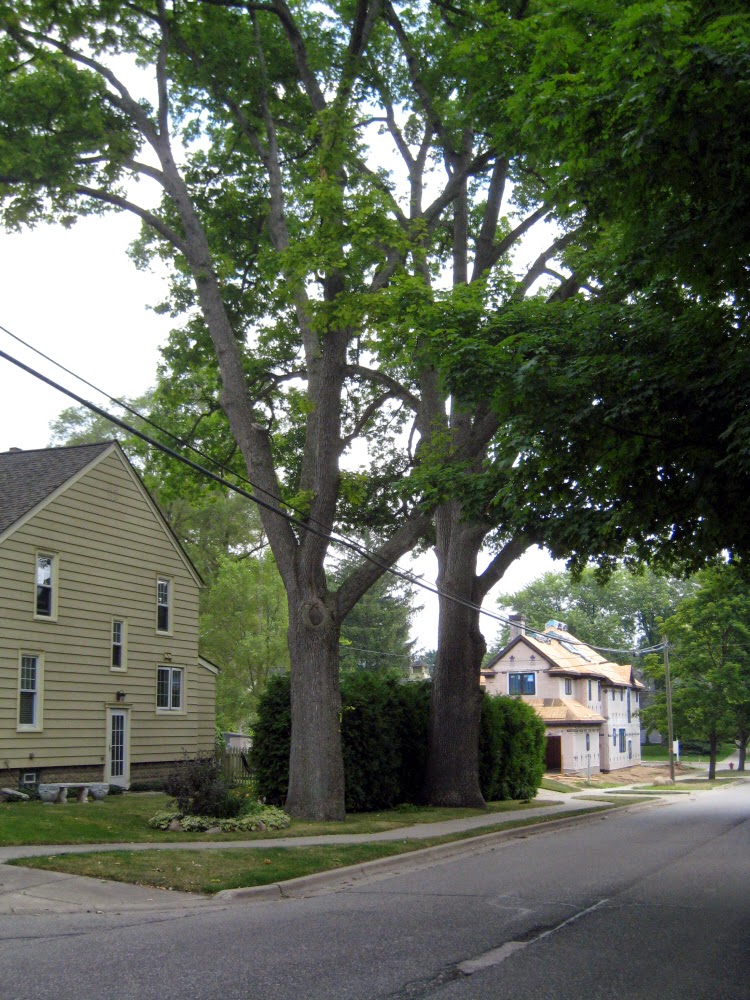
As far as the name of the subdivision itself is concerned, no paper record exists to inform us of the reason for the name, but perhaps we need only to use our eyes. These formidable twin oak trees stand just to the east of the intersection of Third and Wesley, like gatekeepers to the subdivision. It may well have been these trees that inspired Robert Bitters in naming his subdivision.
In 1925, this portion of outlot 14 was platted by owner Robert H. Bitters, who named the new subdivision Twin Oaks. Plat names often reflect the names of their developers, and sometimes the streets in the subdivision are named in honor of their family members. In the case of Twin Oaks, all of the streets in the plat are simply continuations of streets that had already been laid out in the older plats to the north and east.
As far as the name of the subdivision itself is concerned, no paper record exists to inform us of the reason for the name, but perhaps we need only to use our eyes. These formidable twin oak trees stand just to the east of the intersection of Third and Wesley, like gatekeepers to the subdivision. It may well have been these trees that inspired Robert Bitters in naming his subdivision.
Sunday, July 20, 2014
At Home in Rochester: The Van Hoosen - Case House
This historic house at 522 Oak Street, near the Rochester Municipal Building, is 126 years old this year, and is connected to one of the most prominent families in Rochester's history.
When John Van Hoosen built the house in 1888, his property stretched over 4 lots from Oak Street all the way to Pine Street, and fronted on Paint Creek. In the days before it was re-routed, Paint Creek ran much closer to the foot of Oak Street than it does today, meaning that the lot on which this house stands was once highly-desirable riverfront property.
John Van Hoosen and his wife Mary built the house as their family home, but the couple divorced in 1894 and sold the property to Charles Wallace Case, a young man who was working as a clerk in his uncle Harvey Taylor's hardware store on Main Street. C. W. Case bought out his uncle a few years later and established the C. W. Case Hardware store that was a landmark on Main Street for almost seven decades.
Meanwhile, the Case family occupied this house on Oak Street until Charles Case's death in 1944. Case raised purebred poultry on the property, for which he won many awards and medals in poultry shows nationwide. Several additions have been made to the house over the years and it has been remodeled as a multi-family dwelling, but many of the original exterior details of the house that are visible in an 1897 photo of the building can still be seen today, well over a century later.
The Van Hoosen - Case House is one of Rochester's historic gems.
UPDATE: This house was demolished in fall 2014.
When John Van Hoosen built the house in 1888, his property stretched over 4 lots from Oak Street all the way to Pine Street, and fronted on Paint Creek. In the days before it was re-routed, Paint Creek ran much closer to the foot of Oak Street than it does today, meaning that the lot on which this house stands was once highly-desirable riverfront property.
John Van Hoosen and his wife Mary built the house as their family home, but the couple divorced in 1894 and sold the property to Charles Wallace Case, a young man who was working as a clerk in his uncle Harvey Taylor's hardware store on Main Street. C. W. Case bought out his uncle a few years later and established the C. W. Case Hardware store that was a landmark on Main Street for almost seven decades.
Meanwhile, the Case family occupied this house on Oak Street until Charles Case's death in 1944. Case raised purebred poultry on the property, for which he won many awards and medals in poultry shows nationwide. Several additions have been made to the house over the years and it has been remodeled as a multi-family dwelling, but many of the original exterior details of the house that are visible in an 1897 photo of the building can still be seen today, well over a century later.
The Van Hoosen - Case House is one of Rochester's historic gems.
UPDATE: This house was demolished in fall 2014.
Saturday, July 12, 2014
Bygone Business: Nye Manufacturing Company
If you travel down Oak Street between Third and Fourth, you'll pass an ordinary-looking apartment house in the middle of the block on the west side of the street that doesn't give any outward sign of the history it harbors. But if walls could talk, this building would definitely be a place for us to do some listening.
The Seventh Day Adventist Society of Rochester purchased this lot in 1881 from George W. Vandeventer. Local oral history says that the Society then moved its meeting house from another location to this lot, so the actual date of construction of the building is not known. The Adventist Society sold the property in 1893, when the congregation apparently dissolved, to a local carpenter named Merritt M. Nye.
Merritt Nye turned the building into a factory for his Nye Manufacturing Company, which produced a bean picker of Nye's own patented design. The 1896 plat map of Rochester even shows the Nye Manufacturing Company building at this location. The implement was not an economic success, apparently, for only three years later Nye abandoned the enterprise and returned to his former occupation of carpentry. As for the building, the Rochester Era reported on November 5, 1897: "The Nye Manufacturing Company are turning their shop into a double dwelling house, one of which will be occupied by M. M. Nye and wife." The Rochester correspondent to the Utica Sentinel reported in early 1898 that the work on Nye's double house on Oak was almost complete.
Since 1898, the building that began its life as a church and then became a factory has been used as a multiple family dwelling, probably giving it the additional distinction of being the oldest apartment house in the City of Rochester.
The Seventh Day Adventist Society of Rochester purchased this lot in 1881 from George W. Vandeventer. Local oral history says that the Society then moved its meeting house from another location to this lot, so the actual date of construction of the building is not known. The Adventist Society sold the property in 1893, when the congregation apparently dissolved, to a local carpenter named Merritt M. Nye.
Merritt Nye turned the building into a factory for his Nye Manufacturing Company, which produced a bean picker of Nye's own patented design. The 1896 plat map of Rochester even shows the Nye Manufacturing Company building at this location. The implement was not an economic success, apparently, for only three years later Nye abandoned the enterprise and returned to his former occupation of carpentry. As for the building, the Rochester Era reported on November 5, 1897: "The Nye Manufacturing Company are turning their shop into a double dwelling house, one of which will be occupied by M. M. Nye and wife." The Rochester correspondent to the Utica Sentinel reported in early 1898 that the work on Nye's double house on Oak was almost complete.
Since 1898, the building that began its life as a church and then became a factory has been used as a multiple family dwelling, probably giving it the additional distinction of being the oldest apartment house in the City of Rochester.
Subscribe to:
Posts (Atom)