Saturday, May 25, 2013

Memorial Weekend Fun, Circa 1921

If you're looking for some family entertainment in Rochester this Memorial Day weekend, you'll probably pay a visit to the Greater Rochester Heritage Days in the Rochester Municipal Park.  Rochester has hosted the festival for more than three decades now, and it always delivers fun for all ages while educating audiences about our history.

Well, that's today. Do you know what families did for fun on Memorial Day weekend 92 years ago?  This advertisement from the Rochester Era issue of May 27, 1921 gives us a clue.  Townspeople gathered at the corner of Fourth & Wesley streets for a vaudeville circus called the Robbins Overland Show. This traveling show was started in 1921 by an Eaton Rapids farmer named Cadwell Robbins.  In his 1952 book entitled The Only Eaton Rapids on Earth, historian W. Scott Munn tells us this about Robbins and his show:
He carried a score of actors besides his band and laborers, and gave his audiences a regular circus with all the frills.  The second year was rough going. A farmer does not speak the same language as the "profess," so he bowed out of the picture, and sold out to George Miller, who operated [the show] until 1926 when he disposed of the outfit and joined the Tiger Bill Show, retiring in 1929.

It seems that the Robbins show was short-lived, so this was probably its one and only performance in Rochester.  If you live in the neighborhood of Fourth & Wesley today, imagine looking out your window to see Opal the Wonder Pony and Julia the Educated Monkey parading down your street!

Saturday, May 18, 2013

Bygone Business: Cole Brothers Sugar Bowl

If you are looking for a good place to have dessert in downtown Rochester today, you have several excellent options from which to choose.  In 1921, you probably would have visited the Cole Brothers Sugar Bowl at 433 S. Main (currently occupied by the Funky Frog resale shop).  The building at 431-433 S. Main was built in late 1919 and opened to tenants in 1920.  On April  22, 1921, the Sugar Bowl ice cream and confectionery shop opened to the public in the north side of the building.  The location was an excellent one, being one door south of the Idle Hour Theater, which was the only movie venue in town at the time.  The Sugar Bowl operated in this location until 1930, when Adolph Zimmerman moved his shoe store into the space.

This ad ran in the Rochester Era in on April 29, 1921, just a few days after the store held its grand opening.

Saturday, May 11, 2013

At Home in Rochester: George Washington Vandeventer House

This beautiful upright-and-wing house with Italianate details was built in 1875 by Rochester carriage maker George Washington Vandeventer. Born in New York state in 1829, Vandeventer came to Michigan with his parents in 1836, one year before Michigan became a state. He married Julia Pixley, one of the daughters of Avon Township pioneer Jonathan Pixley, in 1853, and the couple had two children, Marshall and Blanche.

Vandeventer operated his carriage business in Rochester and was active in community affairs. He served three terms as president of the village of Rochester and helped to organize a fire brigade after his original house located on this lot was completely destroyed by fire on March 6, 1875.  This house served as the family home of George Vandeventer until his death in 1909 (Julia had died in 1908), but it remained under the ownership of Vandeventer family members well into the 1930s.  In 1998 it was listed on the Michigan Register of Historic Places and a Michigan Historical Marker was erected on the property.

Saturday, May 4, 2013

Subdivision Stories: Oak Bluff

Lying east of North Main Street and south of Romeo is the Oak Bluff subdivision, platted in 1948.  Frank R. Chapman and his wife, Lou Blackwood Chapman, along with Frank's sister, Doris Chapman Blackwood, developed the subdivision on family property which had originally been part the the Charles Sherwin Chapman estate.  Frank and Doris had grown up in a grand, shingle-style estate house that stood atop the bluff north of the downtown area, overlooking the Western Knitting Mills pond, sometimes known as Chapman Pond. Charles S. Chapman had built the house in 1899, when he was serving as president of Western Knitting Mills, which was at the time Rochester's largest employer.

The Chapman siblings named the streets in the new development after their father, Charles, and their uncle, William Clark Chapman.  They retained ownership of the property on which the estate home stood, but did not live in the house.  After several failed attempts to find a suitable use for the house, the property on which it stood was sold for development in 1968 and the house was razed.

Wednesday, May 1, 2013

This Month in Rochester History

Fifty years ago this month, the Rochester Board of Education was considering how to re-align office space within the school district's buildings.  Some administrative offices were located in a house at the corner of Walton & Livernois, on the high school campus, while the business and personnel offices were housed at the old Stoney Creek School.  In May 1963, the board voted to spend $16,000 to convert the former Harrison school on Fourth Street to and administration building and hired Frank Rewold & Son to do the construction work.  The Harrison building had been declared unfit for classroom use the year before and had sat vacant for several months.  This building, constructed in 1889, is now 123 years old and is still used for administrative purposes today.

Saturday, April 27, 2013

At Home in Rochester: Benajmin C. Harrison House

The house at 420 East Street, known today as the home of the Rochester Folk Workshop, was built in 1870 as the family home of Benjamin C. Harrison and his wife, Almira Fancher Harrison. The Harrisons were married in 1865, and two years later bought two lots on East Street. Tax and census records indicate that the house was built on the southernmost of the two lots in 1870.  Benjamin Harrison was born in New Jersey and was a shoemaker by trade.

In 1873, the Harrisons sold the house and both lots to an Oakland Township farmer named Lemuel W. Shoup and his wife, Laura. Lemuel Shoup was the son of one of Oakland Township's pioneer settlers, Conrad F. Shoup, who had served as the township's treasurer and supervisor. Lemuel's nephew, Frank D. Shoup, was the proprietor of the Rochester Elevator from 1913 to 1922.

The Shoups' daughter, Lydia, married Marcus Eugene Carlton in 1881 and her parents sold the vacant lot to the north of their house to the young couple in 1884 so that they could built their own house. The Carltons hired prominent architect John Scott to design their home, which still stands today at 428 East Street.

Lemuel Shoup left the house at 420 East to another of his daughters, Lillian Shoup Horn, when he died in 1901. Lillian's daughter sold the property in 1919, and after brief ownership by a man named James Wortman, the house was purchased in 1922 by Fred Hart Main.  Fred Main, a carpenter, and his wife, Olive, made their family home there for more than four decades.  Their daughter, Helen V. Main Allen, who grew up in the house, later became the treasurer of Avon Township and served in that office from 1949 until her death in 1970.  The city of Rochester Hills named Helen V. Allen Memorial Park on School Road in her honor.

The property stayed in the Main family until 1970.  In the early 1970s, the current owners, Vincent and Karen Sadovsky, established the Rochester Folk Workshop in the building.

The Benjamin C. Harrison House celebrates its 143rd birthday this year.

Saturday, April 20, 2013

Bygone Business: Hacker Meat Market

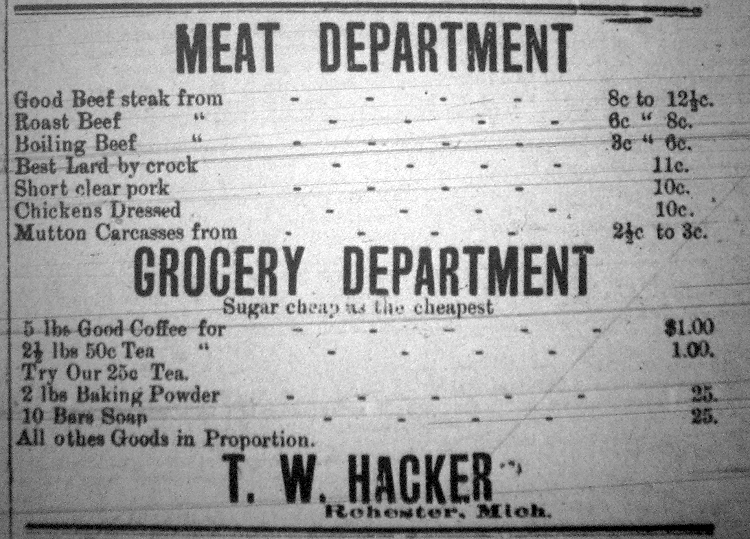
If you were shopping for groceries in Rochester 119 years ago, these are the prices you would have found at the Hacker Meat Market and grocery at 330 S. Main (now 324 S. Main, where O'Connor's Pub is located).  Thomas W. Hacker established his market in Rochester in 1886, and operated it at this location for about 20 years.  This ad from the Rochester Era shows Hacker's prices from 1894, when five pounds of good coffee could be had for $1.00.

Tuesday, April 16, 2013

Where Do You Think You Are - The Route

1. Start on the street corner in front of the old Congregational Church (the old one - not the one where the congregation is currently located on North Pine St.) - This is the northwest corner of Third & Walnut, in front of Smackwater Jack's.
2. Walk a straight path due east to the place that was the site of the first house in Oakland County and the first school in Rochester. This takes you to the Rochester Settlement Marker located on East Third Street at the East Alley.
3. Walk straight north to the corner where the old Village Hall and police station stood. This location is at the northeast corner of Fourth Street and East Alley, where the municipal parking lot is.
4. Walk straight west to the street corner in front of the old 1937 post office building. This is the location of the Penny Black restaurant on the northeast corner of Fourth & Walnut.
5. Walk straight north to the next street intersection. (Intersection of Walnut & West University Drive).Cross the street and walk straight west to the street corner in front of the old Nichols Funeral Home stood (now the corner of West University and Oak Streets; Nichols was the predecessor of Pixley Funeral Home). Walk straight north to the  Charles W. Case house (522 Oak Street).
6. Walk about 220 feet due northeast from the front of the Charles W. Case house. Where are you? You are at the plaza east of the police station entrance where the World War II Honor Roll and Harris Fountain are now located.

If you liked this little exercise, stay tuned, because the Rochester Avon Historical Society's downtown walking tours will soon be starting a new season.  The first walk will be held on Tuesday, May 14 at 7 p.m., and you can meet host and tour guide Rod Wilson in front of the Rochester Mills Brewing Company on Fourth Street. For other tour times and dates, visit the RAHS web site or Facebook page.

Saturday, April 13, 2013

Where Do You Think You Are?

OK, history buffs and long-time Rochester residents, here's a geography quiz for you. All you have to do is follow the instructions listed below from point to point and tell me where you end up!  All locations are within the municipal limits of the City of Rochester, so if you end up out on Avon Road, you to a wrong turn somewhere.  Those who are up for some exercise may want to physically walk the route, but for the rest of you, this trip can probably be taken right inside your head, with or without the aid of a map.  For helpful hints and information about some of the historic sites referenced in the clues, I recommend following the route on the Oakland Regional Historic Sites web site.

Ready? Here we go:
1. Start on the street corner in front of the old Congregational Church (the old one - not the one where the congregation is currently located on North Pine St.)
2. Walk a straight path due east to the place that was the site of the first house in Oakland County and the first school in Rochester.
3. Walk straight north to the corner where the old Village Hall and police station stood.
4. Walk straight west to the street corner in front of the old 1937 post office building.
5. Walk straight north to the next street intersection. Cross the street and walk straight west to the street corner in front of the old Nichols Funeral Home stood. Walk straight north to the  Charles W. Case house.
6. Walk about 220 feet due northeast from the front of the Charles W. Case house.

Where do you think you are?

Feel free to tell me where you ended up in the comments.  I will hold all comments until Tuesday, April 16, and then I will release the comments for publication and post the answer.  Enjoy!

Saturday, April 6, 2013

Pioneer Farmsteads: Albert Terry Farm

Near the southwest corner of Auburn & Livernois roads stands a beautiful brick farmhouse that dates from the Rochester area's pioneer era.  The Greek Revival residence was built by settler Albert Terry about 1840 when the land on which it stands was still wilderness, and it has survived 173 years of development swirling around it.

Albert Terry was born in Livingston County, New York in 1817, the year in which the village of Rochester was founded. He was the eldest of a family of fourteen children. Terry taught school for a time as a youth, and then made a visit to Michigan in 1838. He decided to move permanently to Michigan and returned the following year, when he purchased the northeast quarter of section 33 of Avon Township and thereafter built his home. In the fall of 1839 he returned to New York to claim his bride, Delia Lathrop, and brought her back to his new home in Michigan.  The Terrys  had seven children.  Delia Terry died in 1859, and the following year Terry married Lucina Richardson, the daughter of Isaac Richardson of Pontiac.
The Terry house as it looked in 1877

The farm was prosperous, and Terry added more acreage until he had a farm of 192 acres, one of the largest in the township. He grew fruit and won several agricultural awards for his apples and pears. Albert Terry was a leader in local politics and was elected to the office of Supervisor of Avon Township for 14 years, from 1862 to 1876.

Terry died in 1880; his farm was subsequently owned by Samuel Durrant and later by Georgiana Kersting.

Monday, April 1, 2013

This Month in Rochester History

The members of the first graduating class of Oakland University received their diplomas fifty years ago this month.  Commencement was held on April 19, 1963 for 125 graduating seniors, 19 of whom were residents of the Rochester area.  Beverly Donato of Auburn Hills was valedictorian of the first class to earn degrees from the new university. At the ceremony, Matilda Dodge Wilson received the institution's first ever honorary doctorate.

OU's charter class had enrolled in 1959 with 570 members, but suffered a high rate of attrition. According to the university's web site, so many students flunked their first semester at the new school that officials created a policy whereby failing grades could be "erased" from the student record if the student successfully repeated a failed course.

Half a century later, Oakland University has an enrollment of nearly 20,000 students and a first-year retention rate of better than 70%. The university boasts more than 80,000 alumni.

Saturday, March 30, 2013

At Home in Rochester: Lewis Ward Curtis House

If you've ever visited the Victorian Rose at 118 West Third Street, chances are you've sipped tea in Lewis and Madelin Curtis's living room. Dr. Lewis Ward Curtis and his wife, Madelin Hipp Curtis, built this prairie box style house in 1912; Dr. Curtis had purchased the lot in 1911.

Lewis Ward Curtis was born in Macomb County in 1879, but he grew up in Rochester where his father, James Ewell Curtis, operated the grist mill at the south end of Main Street. (Known for many years as the Curtis Mill, this structure was later known as the Barkham Mill.)  The young Curtis attended Rochester High School and was graduated with the class of 1897. He then enrolled at the University of Michigan College of Dental Surgery and, according to his college yearbook, served as president of his class. After receiving his D.D.S. degree from the University of Michigan in 1902, Curtis returned to his home town to establish a professional practice. He built a brick business block at 307 S. Main in 1907 and later bought property up the street at 315-317 S. Main (where Arizona Saddlery is located today).

Lewis W. Curtis practiced dentistry in Rochester until 1929. He was also very active in community affairs and served as president of the Rochester Board of Education. He died in 1976.  The former Curtis house at 118 W. Third has served as the home of the Victorian Rose Tea Room in recent years; before that it was the home of the offices of Buckerfield Engineering.

Saturday, March 23, 2013

Bygone Business: Rochester Motor Lodge

From the mid-19th century through the early decades of the 20th century, Rochester had two lodging houses - the Lambertson House/St. James Hotel at Fifth and Main, and the Sidney House/Detroit Hotel at Third and Main.  Both of these hotels had faded away by the time of the Great Depression, and for a couple of decades there were no hotels available in Rochester. That changed in the late 1950s, when two new establishments opened: the Spartan Motel on North Hill, and the Rochester Motor Lodge, south of the village.

Rochester Motor Lodge opened in February 1959 in a brand-new building on the west side of South Rochester Road, near the corner of Hamlin. Harold H. Brown was the proprietor, and designed the 12-unit building with the assistance of Mount Clemens architect Elmer Parke.  The Rochester Motor Lodge stood at this location until about 1998, when Walgreens purchased the property as a site for one of their stores.

This advertisement ran in the Rochester Clarion on February 12, 1959, to announce the grand opening of the motel.

Saturday, March 16, 2013

Subdivision Stories: Avon Hills Estates

The Avon Hills Estates subdivision was laid out on the northeast corner of Adams and Auburn roads, south of the old Grand Trunk Railway line,  in 1925. Officially known as Wheaton and Worrall's Avon Hills Estates, the development was created on land that was formerly the farm of Orrin W. Harris and his wife, Dora. Harris's wife died in 1921, and in 1925 he contracted with local developers Arthur O. Worrall and Harold L. Wheaton to transform the property into a subdivision.  Ladd Brothers, a Rochester real estate agency, handled the original sale of the lots.
The streets in Avon Hills Estates were originally named Welling and Sylvan; when Avon Township renamed many of its streets in 1950, Welling became Avalon and Sylvan became St. Clair.

This advertisement for lots in Avon Hills Estates ran in the Rochester Clarion when the subdivision was first opened in 1925.

Saturday, March 9, 2013

Vanished Rochester: Barkham Mill

Barkham Mill (Courtesy Rochester Hills Public Library)
If you could travel back in time to the Rochester of 1900, you would find two grist mills in the downtown area, one standing at each end of Main Street, like bookends. Rochester had been established because of abundant water power along Paint Creek, Stoney Creek and the Clinton River, and the mills that stood along these waterways were the first economic engines of the area. At the north end of the village was the Neely Mill on Paint Creek, and at the south end, near the foot of today's South Hill bridge, was the Barkham Mill.

Steven W. Barkham was the name of the final owner of this mill, which stood on the west side of Main, north of the Clinton River, for ninety years.  It was built in 1837 by Johnson Niles, a founding pioneer of the settlement of Troy Corners, and had many owners and operators in its nine decades of operation.  According to a memoir of Theodor Dahlmann that was published in the Rochester Clarion in 1927, Niles and his business partners sold the mill in 1850 to Charles Nathaniel Griffin, a native of New York, who operated it for nearly ten years before selling out and moving to Detroit.  During the Civil War years, the mill was owned by Baxter Gillett and operated by his brother, Hartson Gillett. Several other owners and partners followed until 1885, when James Ewell Curtis became owner of the business. Curtis, a son of area pioneers, was also the father of Dr. Lewis Ward Curtis, a Rochester dentist who later built business blocks at 307 and 315-317 S. Main Street.  The Curtis heirs sold the grist mill to Steven W. and Beal Barkham in 1903, and so the old wooden structure was known as the Barkham Mill when it was completely destroyed by fire on December 2, 1927, consigning it to the pages of Vanished Rochester.

Saturday, March 2, 2013

At Home in Rochester: Irving J. Coffin House

A stately Dutch colonial home that stands atop a bluff on the west side of North Main Street, between Ferndale and Glendale is connected to a prominent Detroit area man and a tragedy that took his life.  Irving J. "Duke" Coffin built the house in 1927, on a lot he had purchased in 1925.  Coffin was born in Rochester in 1875, and served with the Michigan Naval Brigade aboard the U.S.S. Yosemite during the Spanish-American War. Following the war, he moved to Detroit and worked for the D.U.R. for a few years. In 1910 he took a job as a process server for the Wayne County Prosecutor's office, and worked his way up to county detective. In 1918 he ran a successful campaign for Wayne County Sheriff and served in that position until 1923.

The Rochester Clarion reported in the spring of 1927 that "I. J. Coffin has broken ground for a Dutch colonial type eight-room house on his lot adjoining H.A. George's home on North Main Street." Coffin also owned a farm home two miles north of Rochester, and it is unclear whether he ever lived in the new house in town. On July 28, 1928, Coffin was driving his Lincoln sedan south on Rochester Road when a vehicle turning in front of him forced his car onto the D.U.R. tracks and directly into the path of the oncoming northbound limited interurban car, which was on its way to downtown Rochester.  In the car with Coffin were his eleven-year-old adopted daughter, Evelyn,  and two adult women passengers.  Evelyn Coffin was instantly killed and Irving J. Coffin died of his wounds - a crushed chest and fractured skull - soon after arriving by ambulance at St. Joseph Mercy Hospital in Pontiac.

The funeral service for Irving J. "Duke" Coffin was an impressive one, with full military honors. Fifteen Lincoln sedans were sent out from Detroit by Henry Ford to convey funeral attendees from the home to the cemetery.  Michigan Governor Fred W. Green, who made the trip to Rochester from Lansing by airplane, served as one of the pall bearers.  The Henry Ford band provided music at Mount Avon Cemetery, where Coffin and his daughter were laid to rest.

Friday, March 1, 2013

This Month in Rochester History

Cemeteries were on the minds of Rochester area residents fifty years ago this month. Members of the Avon Township Board of Trustees expressed their extreme displeasure at the application of LePage & Associates to establish and operate a cemetery on Hamlin Road, on land formerly occupied by the Ferry-Morse Seed Farm.  The township itself operated two cemeteries and did not welcome competition from the outside; furthermore, trustees were concerned that the land in question would be removed from the property tax rolls if used for cemetery purposes.  Trustees commented that Avon Township (now Rochester Hills) had "no need" for a new cemetery.

The objections of the township board notwithstanding, the proposed cemetery was soon after established on Hamlin Road as Christian Memorial Cultural Center. It has recently changed names and management and is now known as Christian Memorial Gardens West.

Saturday, February 23, 2013

Old News That's New Again: Community Gardens

Last summer, the City of Rochester established a community garden, and the City of Rochester Hills is planning to establish one this year.  In both cases, the community garden was hailed as something new, but if we turn back 80 years in the pages of Rochester history to the Rochester Clarion issue of June 9, 1933, we find this story on the front page of the newspaper:
WELFARE GARDENS ARE PLANTED
Forty-Seven Acres Sown For Community Project in Avon Township

   Avon Township's Community welfare gardens are underway. Forty-seven acres have been planted to root crops including potatoes, carrots, rutabagas, cabbage, sweet corn, squash, pumpkins and tomatoes. Twenty-seven acres have been tilled and sown on the former J. C. Day farm, just west of the village limits on the Pontiac road and the remaining twenty acres are located on the Crooks road. The gardens are being worked by welfare men using time slips the same as when they worked on the road. It is expected that a sufficient amount of vegetables will be raised on these gardens this summer for next winter's welfare supply.
   In addition to these community gardens, each welfare family has an individual garden which they take care of and have for their own use this summer.
   The township furnished the seeds for this project, purchasing them at a very reasonable price.
   Township officials have secured the assistance of K. D. Bailey, county agricultural agent. Mr. Bailey has stated the gardens were planted in excellent sod and heavy productivity can be assured. He will visit the gardens each month to note their progress and if at any time his assistance is needed he will gladly give it.
Similar projects are being carried out in neighboring townships and cities for their welfare use.

Avon Township is known as Rochester Hills today.  The J. C. Day farm referenced in the story later became known as the Great Oaks Stock Farm, located along West University/Walton on what was formerly referred to as the Pontiac road.

Saturday, February 16, 2013

Bygone Business: South End Garage

1920 newspaper ad for South End Garage
South End Garage was a Rochester institution for over half a century. Opened around 1920 by W. C. Calkins, the business was originally located at 121 S. Main Street, near the foot of the South Hill bridge. In the 1950s, it was located at 101 S. Main, and in 1964, the garage moved to its final location at 198 Diversion Street, just to the east of the South Hill bridge.  All locations were at the south end of town, in keeping with the business name.

After Calkins, South End Garage was operated at various times by Lester F. Pickering, Henry Kraus, and David R. Hoffman. The business closed several years ago, after a long run, but the building still stands on Diversion Street. Readers, if you have more information about this business, or memories of it, please post them in the comments!

Saturday, February 9, 2013

Subdivision Stories: John R Highlands

The John R Highlands subdivision in Rochester Hills is one that has changed greatly from its original plat. The subdivision was laid out in 1924 on the southwest quarter of section 36, previously the farm of August and Caroline Dobat. The Dobats, along with Detroit real estate developer John P. Hehl and the Alex E. Michelson Land and Home Company, platted the land as the John R Highlands subdivision with interior streets named Evans and Ransom.  Ransom Street was presumably named for John P. Hehl's wife, the former Susie Ransom; the origin of the name of Evans Street is unclear.  In any event, both names were changed in 1950 when the Township of Avon renamed many of its streets at the recommendation of the county road commission. At that time, Ransom Street became Michelson, and Evans became Enfield.

The other major change to this plat, as can be seen by comparing a modern map to this original drawing, is that most of the eastern half of the plat is occupied today by Thelma G. Spencer Park and its 38-acre  Frederick S. Carter Lake. The park was opened in 1981.