Showing posts sorted by relevance for query hacker. Sort by date Show all posts

Wednesday, May 19, 2010

Main Street Stories: Thomas W. Hacker block

Thomas W. Hacker built a new brick building at 330 S. Main St. in the summer of 1886, to house his meat market. A description in the Rochester Era gives us a glimpse of what a state-of-the-art meat market looked like 124 years ago:
The new building is 20x70 ft., two stories high, with a fine cellar under all. The salesroom is 20x30 ft., with full plate glass front, and furnished with a marble-top counter. Just back of this room is the ice-box eleven feet square, where the meats for immediate use are kept, the contents being plainly visible through a plate glass front running the width of the box.
The business was known as the Palace Meat Market, and in an ad for the grand opening of the new store, sirloin steaks were offered for twelve cents a pound.
Four years later, there was major activity on the east side of Main, between Third and Fourth, where the Palace Meat Market was located. Charles A. Burr was building the Opera House block, and his brother Frank Burr was building a two-store block adjacent to the Opera House on the south. One lot stood between Frank Burr's new block and the Palace Meat Market, so Thomas W. Hacker tore down the small building that stood there and built another new brick store to fill in the block. The Era reported:
The Hacker brick building adjoining his meat market has been torn down to make room for a new one, which will be erected in connection with the Burr stores. When this full block is completed it will be an ornament and the pride of the village. Work on it is steadily being pushed forward, a full corps of workmen being employed thereon.
The new building bore the address of 332 S. Main. Over the years, occupants of the two Hacker buildings included Wiley & Bitters, the T.E. Nichols Furniture and Undertaking business, Bebout's restaurant, and Mitzelfeld's at 330, and Nichols Furniture, Pixley Furniture and Mitzelfeld's at 332. Once the Mitzelfeld block expanded to absorb the buildings at 330 and 332 S. Main, the storefronts became part of the Mitzelfeld facade and used the Mitzelfeld address number. After Mitzelfeld's closed, the buildings formerly known as 330-332 became 324 S. Main. O'Connor's Public House is currently located there.

This postcard view of the Hacker block from the collection of the Rochester Hills Public Library shows the buildings as they looked around 1912.

Saturday, April 20, 2013

Bygone Business: Hacker Meat Market

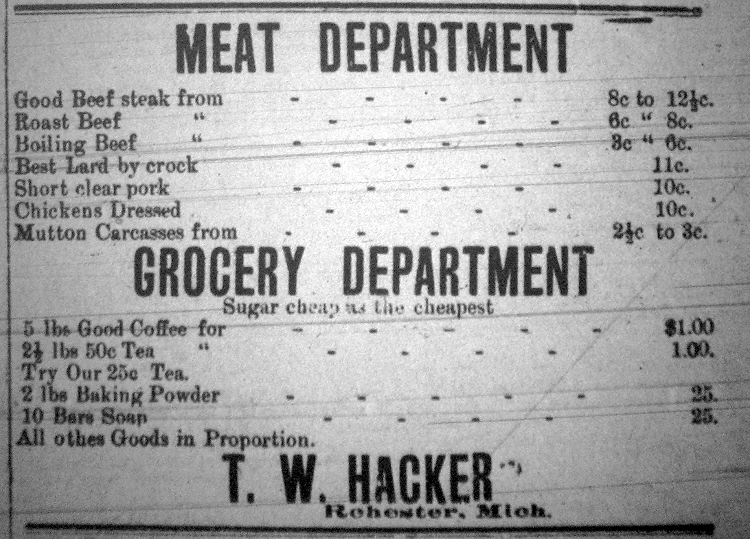
If you were shopping for groceries in Rochester 119 years ago, these are the prices you would have found at the Hacker Meat Market and grocery at 330 S. Main (now 324 S. Main, where O'Connor's Pub is located).  Thomas W. Hacker established his market in Rochester in 1886, and operated it at this location for about 20 years.  This ad from the Rochester Era shows Hacker's prices from 1894, when five pounds of good coffee could be had for $1.00.

Thursday, May 6, 2010

Bygone Business: Rochester Packing

The building at 301 Hacker St., along the Clinton River, that housed the Rochester Packing Company was built in the summer of 1947 by Roy Mason. Mason slaughtered and butchered locally-raised cattle and hogs at his processing plant, and sold his meat at Mason's Market, his retail store at Fourth and West Alley, at the back of the D&C building.

Rochester Packing was later owned by Art and Al Gruener, who sold meat and meat products from a retail counter right at the plant on Hacker. The Grueners closed the business on May 3, 1988.

Anybody else remember taking a grade school field trip tour of the packing house and finding out how sausage is made, up close?

This ad for the Rochester Packing Company ran in the Clarion in 1964.

Friday, November 23, 2012

Subdivision Stories: Charles O. Renshaw Subdivision

The Charles O. Renshaw subdivision on the south side of the Village of Rochester was platted in 1896 and was the fourth addition made to the original village plat during the nineteenth century.  Streets were laid out on the former farm land of Charles O. Renshaw and his wife Harriet Castleman Renshaw, who were both born in England and had emigrated to the United States just before the Civil War.

The Renshaw addition lay south of First Street and included the streets named Renshaw, Quarter, Peach, West, Hacker and Helmond Streets. Helmond was originally named Harrison on the subdivision plat, but was renamed in 1950 to avoid confusion with another Harrison Street in the village.

Charles and Harriet Renshaw reared a family of nine children in Rochester. Harriet Renshaw died in 1904, and Charles Renshaw died in 1909.  Both are buried at Mount Avon Cemetery.