Sunday, September 1, 2013

This Month in Rochester History

Honor Roll moving in 1963 (Rochester Hills Public Library)
Fifty years ago this month, Rochester leaders were contemplating what should be done with the community's World War II honor roll, which had fallen into disrepair and was standing in the way of a proposed urban renewal project.

In 1963, the honor roll was located on the east side of Main Street at Second; Second street had not been opened east of Main at that time. The village was preparing for an urban renewal project on the east side of Main, encompassing the area occupied by the former Chapman Mill Pond (which had been washed out in 1946) and adjacent property.  Part of this plan was to open Second Street east of Main.

The village fathers and the Blue Star Mothers, who had originally sponsored the creation of the memorial, contemplating moving the memorial to the municipal building grounds, as this article from the September 26, 1963 issue of the Rochester Clarion reported:
Township treasurer Helen V. Allen, representing the Blue Star Mothers, addressed a letter to the Council asking them to consider a spot for the memorial on the Civil Center grounds.
The memorial is now located on Main St. across the road from the eastern end of Second. Because the names are etched on glass, some of the panels are broken and the memorial in general is in poor condition. It is believed that stones thrown up by passing cars have broken the glass panels.
Mrs. Allen said this week that the Blue Star Mothers have brought a glass company person to Rochester to look at the memorial and it is estimated it will cost $600 to repair the memorial. It will cost an unestimated amount to move the memorial. She said that the Blue Star Mothers will ask other organizations and individuals to help them finance the project.
Honor Roll at re-dedication in 2002 (Rod and Susan Wilson)
The planned move to the municipal building grounds did not happen in 1963. Instead, the honor roll was removed from its site at Second Street and dismantled. The broken panels were stored away in a garage and not seen again for several decades, until the Rochester Avon Historical Society adopted the honor roll as a historic preservation project and restored it.  At a cost many thousands of dollars greater than the estimate of 1963, the memorial was returned to its former glory and given a place of honor on the grounds of the Rochester Municipal Building in 2002. It was re-dedicated on Memorial Day of that year with many local World War II veterans in attendance.

If you haven't visited Rochester's World War II Honor Roll, be sure to take time to stop by the Municipal Building to view this memorial to the more than 1,100 men and women from the community who served in uniform during World War II.  Among the names listed are 26 preceded by gold stars, denoting the ultimate sacrifice in defense of freedom.


Saturday, August 31, 2013

At Home in Rochester: Erastus H. Sipperley House

Tucked away from the hustle and bustle of the community at the end of Bloomer Road is this handsome brick Victorian, originally built as the farm home of Erastus H. Sipperley.  Today, the house stands upon the remnant of what was at one time a one hundred acre farm.

The Sipperley family came to Oakland County from New York in 1835, while Michigan was still a territory. John and Elizabeth Sipperley made their home in Troy Township, where their son, Erastus H., was born in 1836. Erastus worked on his father's farm until August 1862, when he entered service in the Union army with the 22nd Michigan Volunteer Infantry.  His regiment was assigned to the pursuit of the Confederate general Braxton Bragg, and suffered heavy losses at the battle of Chickamauga, but Sipperley himself escaped harm and returned to Oakland County at the close of the war.

In 1870, Erastus Sipperley married Annette Evritt and moved from his father's farm to a parcel of land in section 13, Avon Township, where he built the house shown here as a family residence.  The couple reared eight children here.
Erastus Sipperley house as it looked in 1907

An 1891 local history book entitled Portrait and Biographical Album of Oakland County, Michigan had this to say about the Erastus Sipperley farm:
One of the most attractive farms in Avon township is owned and occupied by this gentleman [Erastus Sipperley] .  The home place consists of one hundred acres, which are cultivated in a careful and intelligent manner and have their fertility kept at par by a  judicious rotation of crops and the use of drainage of fertilizing agencies when  necessary. A complete line of farm buildings stands upon the estate, modern machinery is in use during the season of planting and reaping, and the stock of high grade grazes in the pastures.  The dwelling is of unusually pleasing design, is a model of neatness and comfort, and in its surroundings gives evidence of the refined taste of the family.  It was built in 1885. 
 Erastus Sipperley died in 1920 and is buried in Mount Avon Cemetery.  His home on Bloomer Road is 128 years old this year.

Saturday, August 24, 2013

Ford Photographic Farm

A 1964 Rochester Clarion photo of promotional photography being done at the Ford Photographic Farm on the former Ferry-Morse Seed Farm property.
If you're watching closely, you've seen glimpses of downtown Rochester in the background of some recent automobile commercials on television, and Michigan's film program has brought a number of location shoots to our area over the past few years.  But if you think using Rochester as a film backdrop is a new development, think again!

In May 1963,  Ford Tractor & Implement Operations leased 717 acres of the former Ferry-Morse Seed Farm lying east of Rochester Road and south of Hamlin from then-owner Howard L. McGregor.  The property was, at that time, a real working farm that was part of McGregor's Great Oaks Stock Farm holdings.  Ford Tractor was looking for property within a reasonable distance from its Birmingham offices on which to shoot photographs of its equipment in authentic farm situations, and the former Ferry property was the best candidate because of its size.

Loyce Snyder of Rochester was the supervisor of the photographic section of Ford Tractor's advertising and sales promotion department, which operated the Ford Photographic Farm.  Photos taken at the farm were used in sales brochures and national print advertising campaigns, but the company also shot about a dozen motion pictures at the site each year. Some backdrop shots were also taken in and around the village of Rochester.  These films were used for sales training or product demonstration purposes nationwide.
A 1964 national ad campaign for Ford used downtown Rochester looking north from Third Street as a background. The town was not identified in the ad, but everybody from the "Heart of the Hills" recognized their hometown.

Few people knew much about what was happening at the Ford Photographic Farm because it was not open to visitors, but examples of its work can be found in vintage Ford Tractor ads.  Tractor lovers, if you've got any 1960s-era promotional literature stored away, be sure to look for glimpses of the Rochester area in the photo backgrounds. You may see something you recognize!

Saturday, August 10, 2013

A Distinguished Visitor

Near the end of World War II, the Rochester community was visited by a world-renowned figure, but few people in town knew about the event until it was over.  On June 15, 1945, the Parke-Davis Biological Farm on Parkdale Road was toured by none other than Sir Alexander Fleming - the man who had discovered that penicillium fungi, when properly cultured, would produce a substance with antibiotic properties.  Fleming's 1928 discovery led to the development of the penicillin family of antibiotics just in time for them to be used as a life-saving treatment for soldiers injured during the Normandy invasion in World War II.

The Rochester Clarion told the community that Fleming had visited them in the issue of June 21, 1945. The newspaper said in part:
Few people in Rochester were aware last Friday afternoon, of a most famous visitor in our midst, Sir Alexander Fleming, the discoverer of penicillin, who spent an hour visiting the Parke Davis Biological farms, east of the village.
. . .
From the people who saw this famous man, last Friday, he impressed them that he didn't consider himself as great. In fact he looked and acted very much like a hard-headed little Scot who is very much perturbed over the great ado being made over him.
A most interesting description was given of him by Malcolm Bingay in his recent column in the Detroit Free Press from which we quote: "By chance I left the farm where my people still are, by chance I got a clerkship in a steamship line, by chance I entered St. Mary's Hospital Medical school, by chance I discovered penicillin. All life is chance."

After concluding his tour of Parkedale, Fleming and his secretary returned to Detroit where they visited Henry Ford Hospital.  Fleming and two other scientists were awarded the Nobel Prize in Physiology and Medicine for their work with penicillin later that year.

Sunday, August 4, 2013

Bygone Business: The Food Tray

How many Remembering Rochester readers recall this little delicatessen and party store, tucked into the back of the building on the northeast corner of Second & Main streets?  The Food Tray opened at that location in June 1957, and was originally owned and operated  by Mr. and Mrs. Frank Bozynski.  Raymond and Lillian Brinker later owned the business, which operated in the same location at 204 S. Main until the mid-1980s.

This photo of Mr. & Mrs. Bozynski in their new store was published in the Rochester Clarion in 1957 to announce the grand opening of the business.

Thursday, August 1, 2013

This Month in Rochester History

Plans for a new building on the corner of Oak Street and West University Drive were occupying the attention of Rochester residents fifty years ago this month.  In August 1963, Pixley Funeral Home unveiled drawings for a new, Colonial-style building designed by architect Edward J. Heins of Rochester.  The new building would be state-of-the-art, with five reposing rooms on the first floor and an eight-car garage in the rear.

Pixley Funeral Home has deep roots in Rochester going back more than a century. The business traces its origin to the Thomas E. Nichols funeral home started here in 1910. Vern Pixley joined the Nichols business on January 2, 1918, and later acquired a half interest in the company.  In 1954, the firm was incorporated as the Pixley Funeral Home.

Saturday, July 27, 2013

Vanished Rochester: Posey's Isle

Posey's Isle as it looked in September 1958 (Courtesy of Yates Cider Mill)
This popular drive-in known as Posey's Isle was located on the southwest corner of Avon and Dequindre roads. It was built in 1942 by Charles M. Posey, who purchased the land from the Yates family and built the restaurant for his wife, Ruth Renwick Posey.  The Poseys,  who bought the Yates Cider Mill from Harry L. Yates in 1959, sold Posey's Isle in that same year but bought it back during the 1970s, and operated it until the mid-1980s.

The little drive-in was torn down just a few years ago. Yates Cider Mill is going strong, however  -  still operated by Posey family members. The business is about to celebrate its 150th year of existence and its 137th year of pressing cider.  And although Posey's Isle has passed into the pages of Vanished Rochester, Yates Cider Mill still offers a very tempting menu of delicious treats in the tradition that Ruth Posey started in 1942.

My thanks to Mike Titus and Hannah Springer of Yates Cider Mill for lending the photo and providing the history of Posey's Isle.

Saturday, July 20, 2013

Bygone Business: Hayward Bowling Alley

If you ask long-time Rochester residents about bowling on Main Street, they will probably tell you that they patronized the bowling alley in the basement of the Whims building, which was built in 1926.  But this newspaper advertisement from September 1903 shows us that there was a bowling alley on Main Street long before the one in the Whims building opened.

The Hayward bowling alley was located in a building on the southwest corner of Fourth & Main streets, on the lot where the Chase Bank stands today.  (The building was torn down in 1924 when construction of the bank building commenced.)  Nothing much is known about proprietor Daniel Hayward. It seems that he and his bowling alley didn't last long in Rochester.

Saturday, July 13, 2013

Movers and Shakers: C. Lawrence "Larry" Jerome

If you were living in Rochester in 1970 or earlier, you probably recognize the name of Larry Jerome, who was a prominent business and civic leader in the community for over 40 years. Known as the owner of Larry Jerome Ford Sales and Service which was located for decades at 215 S. Main, Jerome was also a charter member of the Rochester Kiwanis Club and served terms as president of the board of education and chamber of commerce.

A lengthy interview with Larry Jerome was published in the August 6, 1937 issue of the Rochester Clarion, and relates a very interesting life story.  Jerome was born in 1901 in Detroit, Michigan, the son of John Jerome and Eva Ireland. He attended high school in Detroit, but visited Rochester with his friends at the age of fourteen, when the group of boys took a canoe trip along the Clinton River from Pontiac to Lake St. Clair.  The Clarion reported:
...four weary boys, who had paddled their canoe down the Clinton river a long, tiresome day, brought their boat to rest where the river passes through Rochester and prepared to camp for the night.
'Gee, this is a pretty town,' exclaimed one of the lads, after they had set up their tents and were looking over the village, 'I'd like to settle down and live in a town like this someday.' But Charles Lawrence Jerome, the fourteen year old boy who liked the looks of Rochester, known today as "Larry" Jerome, popular Ford dealer here, little imagined that only seven years later he would be settling down in Rochester and embarking on his life work of selling and servicing automobiles to residents here and throughout the countryside.
The seven years that passed between Jerome's canoe trip to Rochester and his arrival here as an adult businessman were busy ones.  He enlisted in the U.S. Navy while still underage and spent a summer cruising the Great Lakes on a naval training vessel.  He was quickly discharged as ineligible for duty when World War I broke out.  He finished high school and enrolled in college where he participated in the Students' Naval Training Corps at the University of Michigan, but never saw active service before the war ended.

After leaving college, Larry Jerome found his first job in the automobile industry, working for a used car dealer in Detroit. Jerome's job was to travel the countryside buying used cars for resale. One of the firms he regularly called upon was the Phillips & Bailey Ford dealership in Rochester. After he married in 1921, Larry Jerome decided that he would have better business opportunities in a small town than he would in a city as large as Detroit, so he went to work as a salesman for Phillips & Bailey in the town he had admired when on his canoe trip seven years earlier.  In 1924, when W. J. Bailey was offered the Ford dealership in Romeo, Larry Jerome bought his share of the Rochester dealership and it became known as Phillips & Jerome.  Not many years later, Jerome bought out his partner, O. N. Phillips, and Larry Jerome Ford was born.

In his 1937 interview with the Clarion, Larry Jerome gave his perspective on what made a successful auto dealership:
'The success or failure of an automobile agency,' says Mr. Jerome, 'does not depend on the front office or salesrooms. In the long run the success of an automobile dealer depends on how his back shop is operated.  The first thing that attracted me to Ford, even before I entered the automobile business, was the fact that Ford insisted, not only in selling cars at a low price, but also that his dealers be equipped to make necessary repairs as efficiently and as economically as possible. If, after you sell a customer an automobile, you are able to keep his car running satisfactorily at a minimum expense, you are pretty certain to sell him his next car.'

Larry Jerome operated his very successful Rochester dealership until the mid-1960s, when he sold the business to Jack Long. The McKenzie Ford dealership followed Long, and moved the dealership out of downtown to South Hill.  Larry Jerome died in 1971.

In the 1957 promotional photo shown here, Larry Jerome (right) and his son, Dick Jerome, are looking at a new Ford Skyliner with Jim Scolaro and Mickey Niles.

Saturday, July 6, 2013

Subdivision Stories: Hitchman's Haven Estates

The subdivision known as Hitchman's Haven Estates was platted in the southeast quarter of Section 8 of the former Township of Avon (now Rochester Hills) in 1952.  Detroit real estate broker Thomas A. Hitchman and his wife, Ada Lillian Sternbridge Hitchman, developed the subdivision that bears their name; they included the name "Haven" in a nod to the Haven Sanitarium that lay adjacent to their property immediately to the east.  The streets in the original Hitchman's Haven Estates development were named for the western states of Texas and Nevada.  The Hitchmans expanded the subdivision in 1953, adding the streets of Arizona and Oklahoma, and again in 1955, adding a fifth street named Colorado.

An interesting side note about this property is that before the Hitchmans acquired it for development, the parcel was owned by Beryl Harnett Schuyler Kahn, who was the wife of Detroit architect Louis Kahn (not to be confused with the famous Estonian-born architect Louis I. Kahn of the Yale School of Architecture).  Detroit architect Louis Kahn was the brother of renowned industrial architect Albert Kahn.

Monday, July 1, 2013

This Month in Rochester History

Fifty years ago this month, a group of Rochester citizens traveled to Pennsylvania to join historians and re-enactors in a centennial observance of the anniversary of the Battle of Gettysburg.  Rochester police sergeant Raymond Russell (himself a Civil War historian) along with his son, Brian, and another local family spent a week in an encampment near the famous battlefield.  Dressed in Union blue, they participated in battle re-enactments and the re-dedication of two of the memorials located there.

This week, thousands of visitors will be in Gettysburg to commemorate the 150th anniversary of the pivotal battle. Click here for information about the events that will be unfolding in the next few days.

Friday, June 28, 2013

Bygone Business: Burr's B-Z Bootery

B-Z Bootery grand opening ad, May 1957
Burr's Bootery was located at 433 S. Main and was owned and operated by Rochester native Jack C. Burr. The shoe store held its grand opening in May 1957, and was the direct successor of the Adolph Zimmerman store than had been established a quarter of a century earlier and had moved to 433 S. Main in 1930.

After completing his service in the U.S. Air Force, during which he flew the F-86 Sabre in the Korean War, Jack Burr returned to Rochester and bought the Zimmerman shoe store. At first the new business was advertised as the Zimmerman B-Z Bootery, as seen in the grand opening advertisement shown here, but eventually the name changed to Burr's B-Z Bootery.

Jack Burr operated this store at 433 S. Main until 1992. He must have outfitted thousands of Rochester kids with their "school shoes" over his three-and-a-half decades in the business.  He died in 2003.

Saturday, June 22, 2013

Whims Insurance is a Michigan Milestone Business

(Photo courtesy of Connie Klix-Mercer)
Whims Insurance Agency of Rochester has just been recognized by the Historical Society of Michigan with a Michigan Milestone Business award for 96 years of continuous service to the community.  The company's history stretches back to April 1917, when Rochester automobile dealer Leslie L. Whims was approached by the Auto-Owners Insurance Company to act as a local agent for its products.  Whims became an Auto-Owners representative, and nearly a century later, the agency that still bears his name continues that relationship and owns the distinction of being the third-oldest Auto-Owners agency in the nation.

(Leslie Whims is also remembered for the commercial building he erected at 430 S. Main in 1926, where a couple of generations of Rochester's youth enjoyed bowling in the building's basement alleys.)

Congratulations to Whims Insurance Agency, a Michigan Milestone business and a valued Rochester institution!

Saturday, June 15, 2013

Rochester on the Road: Yawkey Hall

If you own property in the Yawkey and Chapman subdivision on South Hill, the name shown in this photo may look familiar to you. This town hall  is located in the small village of Hazelhurst, Wisconsin, lying just northwest of the larger town of Rhinelander. Standing on Yawkey Street in Hazelhurst, Yawkey Hall is named in honor of William Clyman Yawkey and his nephew, Cyrus C. Yawkey, Michiganders who founded the Yawkey Lumber Company there in 1893. The Yawkey company owned and processed three hundred million feet of standing timber in the Hazelhurst area during the heyday of the lumber industry.

 William C. Yawkey was also heavily invested in Michigan timber stands and in several Detroit businesses; at one point he was considered to be the richest man in Michigan. In 1891 he had become president of the Western Knitting Mills and moved the company to Rochester, taking over the old Rochester Woolen Mill property.  His partners in that concern were Charles S. and William C. Chapman, who had also worked for him in his Wisconsin lumber business; the partners built a new, state-of-the-art woolen mill on the Rochester site in 1896.

In Rochester, William C. Chapman moved into the real estate development business at the turn of the twentieth century, as the community saw a boom after the arrival of the interurban line and the sugar beet factory.  Chapman and Yawkey invested together in property on the southern edge of the village of Rochester, and there platted the Yawkey and Chapman subdivision.

The Yawkey name is also associated with sports history, as William C. Yawkey's son, William Hoover Yawkey, was the sole owner of the Detroit Tigers baseball franchise from 1903 to 1908, and part owner with Frank Navin from 1908 to 1919.

If you ever find yourself in Hazelhurst, Wisconsin, be sure to stop by and visit this connection to Rochester history.

Saturday, June 8, 2013

Vanished Rochester: David Wagner Butts Farmhouse

(Photo courtesy of Rod and Susan Wilson)
For half a century, the David Wagner Butts farmhouse stood atop South Hill at the location where the Bill Fox dealership is today.  The Rochester Era noted in February 1906 that: "D. W. Butts is getting material on the ground for a new brick residence on his farm just south of Rochester, in the spring." Although the house wasn't built until the first decade of the 20th century, the property on which it stood had been in the Butts family since 1855. In that year, Elias and Catherine Butts (also sometimes spelled Butz) migrated west to Michigan from New Jersey. Their son, David, was nine years old at the time the Butts family established their farm in Avon Township.

David took over the farm from his father and built this home for his own family, including his wife Juliet Bromley Butts, and daughters Elizabeth and Laura.  In addition to crops, David Butts raised Belgian and Clydesdale horses, and sold two to three teams a year, according to an interview given by his daughter, Elizabeth, in 1944.

Elizabeth "Lizzie" Butts Case and her sister Laura Butts Cross eventually inherited the South Hill property, but nobody lived in the house after 1964 and it fell victim to vandals. Laura Cross and her niece, Della Wilson (Elizabeth Case's daughter), decided to have the house razed in 1976 and it fell to a wrecker's ball on August 12 of that year.

In an interview with the Rochester Clarion given at the time the house was slated for demolition, Della Wilson remembered that her grandfather, David Butts, maintained an athletic field for the community on part of his farmland that lay between the house and South Street. She recalled:
The park was like an amphitheater - it was beautiful. My grandfather would mow it and fix the neighbors' fences when the kids broke them down every year.
Mrs. Wilson recalled that her grandfather's ballpark was used for three generations, until Halbach Field was opened in the village in the mid-1920s.


Saturday, June 1, 2013

This Month in Rochester History

Fifty years ago this month, citizens of Rochester were learning a new number - right along with everyone else in the United States. In June 1963 the United States Postal Service began to roll out its new Zone Improvement Program, which sorted mail by five-digit numbers popularly known as zip codes.  Rochester residents were assigned the zip code 48063.

The challenge for the postal service was to encourage public cooperation with the new plan.  A cartoon character named Mr. Zip showed up in advertising media to cajole postal customers into learning and using their new zip codes.  There was even a zip code song - click this link if you'd like to hear it.

In the late 1980s, population shifts in southeastern lower Michigan necessitated a revised zip code map, and the Rochester area received new zip codes of 48306, 48307 and 48309, while our old zip code of 48063 was reassigned to Columbus Township in St. Clair County.

Saturday, May 25, 2013

Memorial Weekend Fun, Circa 1921

If you're looking for some family entertainment in Rochester this Memorial Day weekend, you'll probably pay a visit to the Greater Rochester Heritage Days in the Rochester Municipal Park.  Rochester has hosted the festival for more than three decades now, and it always delivers fun for all ages while educating audiences about our history.

Well, that's today. Do you know what families did for fun on Memorial Day weekend 92 years ago?  This advertisement from the Rochester Era issue of May 27, 1921 gives us a clue.  Townspeople gathered at the corner of Fourth & Wesley streets for a vaudeville circus called the Robbins Overland Show. This traveling show was started in 1921 by an Eaton Rapids farmer named Cadwell Robbins.  In his 1952 book entitled The Only Eaton Rapids on Earth, historian W. Scott Munn tells us this about Robbins and his show:
He carried a score of actors besides his band and laborers, and gave his audiences a regular circus with all the frills.  The second year was rough going. A farmer does not speak the same language as the "profess," so he bowed out of the picture, and sold out to George Miller, who operated [the show] until 1926 when he disposed of the outfit and joined the Tiger Bill Show, retiring in 1929.

It seems that the Robbins show was short-lived, so this was probably its one and only performance in Rochester.  If you live in the neighborhood of Fourth & Wesley today, imagine looking out your window to see Opal the Wonder Pony and Julia the Educated Monkey parading down your street!

Saturday, May 18, 2013

Bygone Business: Cole Brothers Sugar Bowl

If you are looking for a good place to have dessert in downtown Rochester today, you have several excellent options from which to choose.  In 1921, you probably would have visited the Cole Brothers Sugar Bowl at 433 S. Main (currently occupied by the Funky Frog resale shop).  The building at 431-433 S. Main was built in late 1919 and opened to tenants in 1920.  On April  22, 1921, the Sugar Bowl ice cream and confectionery shop opened to the public in the north side of the building.  The location was an excellent one, being one door south of the Idle Hour Theater, which was the only movie venue in town at the time.  The Sugar Bowl operated in this location until 1930, when Adolph Zimmerman moved his shoe store into the space.

This ad ran in the Rochester Era in on April 29, 1921, just a few days after the store held its grand opening.

Saturday, May 11, 2013

At Home in Rochester: George Washington Vandeventer House

This beautiful upright-and-wing house with Italianate details was built in 1875 by Rochester carriage maker George Washington Vandeventer. Born in New York state in 1829, Vandeventer came to Michigan with his parents in 1836, one year before Michigan became a state. He married Julia Pixley, one of the daughters of Avon Township pioneer Jonathan Pixley, in 1853, and the couple had two children, Marshall and Blanche.

Vandeventer operated his carriage business in Rochester and was active in community affairs. He served three terms as president of the village of Rochester and helped to organize a fire brigade after his original house located on this lot was completely destroyed by fire on March 6, 1875.  This house served as the family home of George Vandeventer until his death in 1909 (Julia had died in 1908), but it remained under the ownership of Vandeventer family members well into the 1930s.  In 1998 it was listed on the Michigan Register of Historic Places and a Michigan Historical Marker was erected on the property.

Saturday, May 4, 2013

Subdivision Stories: Oak Bluff

Lying east of North Main Street and south of Romeo is the Oak Bluff subdivision, platted in 1948.  Frank R. Chapman and his wife, Lou Blackwood Chapman, along with Frank's sister, Doris Chapman Blackwood, developed the subdivision on family property which had originally been part the the Charles Sherwin Chapman estate.  Frank and Doris had grown up in a grand, shingle-style estate house that stood atop the bluff north of the downtown area, overlooking the Western Knitting Mills pond, sometimes known as Chapman Pond. Charles S. Chapman had built the house in 1899, when he was serving as president of Western Knitting Mills, which was at the time Rochester's largest employer.

The Chapman siblings named the streets in the new development after their father, Charles, and their uncle, William Clark Chapman.  They retained ownership of the property on which the estate home stood, but did not live in the house.  After several failed attempts to find a suitable use for the house, the property on which it stood was sold for development in 1968 and the house was razed.

Wednesday, May 1, 2013

This Month in Rochester History

Fifty years ago this month, the Rochester Board of Education was considering how to re-align office space within the school district's buildings.  Some administrative offices were located in a house at the corner of Walton & Livernois, on the high school campus, while the business and personnel offices were housed at the old Stoney Creek School.  In May 1963, the board voted to spend $16,000 to convert the former Harrison school on Fourth Street to and administration building and hired Frank Rewold & Son to do the construction work.  The Harrison building had been declared unfit for classroom use the year before and had sat vacant for several months.  This building, constructed in 1889, is now 123 years old and is still used for administrative purposes today.

Saturday, April 27, 2013

At Home in Rochester: Benajmin C. Harrison House

The house at 420 East Street, known today as the home of the Rochester Folk Workshop, was built in 1870 as the family home of Benjamin C. Harrison and his wife, Almira Fancher Harrison. The Harrisons were married in 1865, and two years later bought two lots on East Street. Tax and census records indicate that the house was built on the southernmost of the two lots in 1870.  Benjamin Harrison was born in New Jersey and was a shoemaker by trade.

In 1873, the Harrisons sold the house and both lots to an Oakland Township farmer named Lemuel W. Shoup and his wife, Laura. Lemuel Shoup was the son of one of Oakland Township's pioneer settlers, Conrad F. Shoup, who had served as the township's treasurer and supervisor. Lemuel's nephew, Frank D. Shoup, was the proprietor of the Rochester Elevator from 1913 to 1922.

The Shoups' daughter, Lydia, married Marcus Eugene Carlton in 1881 and her parents sold the vacant lot to the north of their house to the young couple in 1884 so that they could built their own house. The Carltons hired prominent architect John Scott to design their home, which still stands today at 428 East Street.

Lemuel Shoup left the house at 420 East to another of his daughters, Lillian Shoup Horn, when he died in 1901. Lillian's daughter sold the property in 1919, and after brief ownership by a man named James Wortman, the house was purchased in 1922 by Fred Hart Main.  Fred Main, a carpenter, and his wife, Olive, made their family home there for more than four decades.  Their daughter, Helen V. Main Allen, who grew up in the house, later became the treasurer of Avon Township and served in that office from 1949 until her death in 1970.  The city of Rochester Hills named Helen V. Allen Memorial Park on School Road in her honor.

The property stayed in the Main family until 1970.  In the early 1970s, the current owners, Vincent and Karen Sadovsky, established the Rochester Folk Workshop in the building.

The Benjamin C. Harrison House celebrates its 143rd birthday this year.

Saturday, April 20, 2013

Bygone Business: Hacker Meat Market

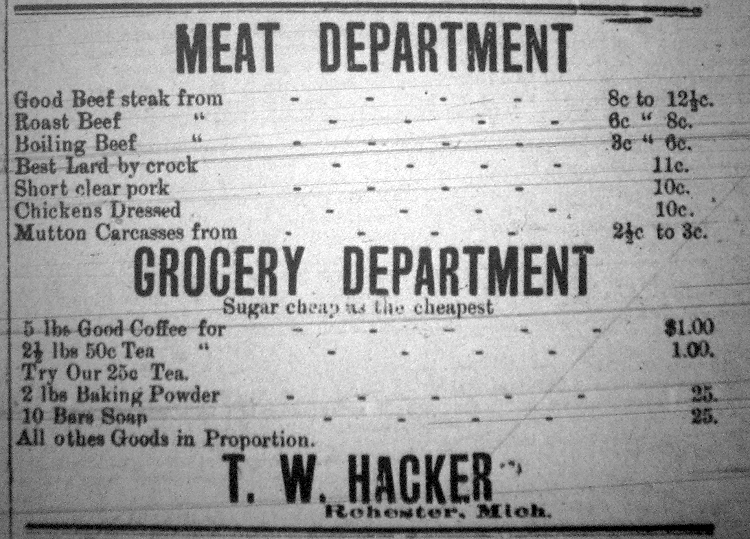
If you were shopping for groceries in Rochester 119 years ago, these are the prices you would have found at the Hacker Meat Market and grocery at 330 S. Main (now 324 S. Main, where O'Connor's Pub is located).  Thomas W. Hacker established his market in Rochester in 1886, and operated it at this location for about 20 years.  This ad from the Rochester Era shows Hacker's prices from 1894, when five pounds of good coffee could be had for $1.00.

Tuesday, April 16, 2013

Where Do You Think You Are - The Route

1. Start on the street corner in front of the old Congregational Church (the old one - not the one where the congregation is currently located on North Pine St.) - This is the northwest corner of Third & Walnut, in front of Smackwater Jack's.
2. Walk a straight path due east to the place that was the site of the first house in Oakland County and the first school in Rochester. This takes you to the Rochester Settlement Marker located on East Third Street at the East Alley.
3. Walk straight north to the corner where the old Village Hall and police station stood. This location is at the northeast corner of Fourth Street and East Alley, where the municipal parking lot is.
4. Walk straight west to the street corner in front of the old 1937 post office building. This is the location of the Penny Black restaurant on the northeast corner of Fourth & Walnut.
5. Walk straight north to the next street intersection. (Intersection of Walnut & West University Drive).Cross the street and walk straight west to the street corner in front of the old Nichols Funeral Home stood (now the corner of West University and Oak Streets; Nichols was the predecessor of Pixley Funeral Home). Walk straight north to the  Charles W. Case house (522 Oak Street).
6. Walk about 220 feet due northeast from the front of the Charles W. Case house. Where are you? You are at the plaza east of the police station entrance where the World War II Honor Roll and Harris Fountain are now located.

If you liked this little exercise, stay tuned, because the Rochester Avon Historical Society's downtown walking tours will soon be starting a new season.  The first walk will be held on Tuesday, May 14 at 7 p.m., and you can meet host and tour guide Rod Wilson in front of the Rochester Mills Brewing Company on Fourth Street. For other tour times and dates, visit the RAHS web site or Facebook page.

Saturday, April 13, 2013

Where Do You Think You Are?

OK, history buffs and long-time Rochester residents, here's a geography quiz for you. All you have to do is follow the instructions listed below from point to point and tell me where you end up!  All locations are within the municipal limits of the City of Rochester, so if you end up out on Avon Road, you to a wrong turn somewhere.  Those who are up for some exercise may want to physically walk the route, but for the rest of you, this trip can probably be taken right inside your head, with or without the aid of a map.  For helpful hints and information about some of the historic sites referenced in the clues, I recommend following the route on the Oakland Regional Historic Sites web site.

Ready? Here we go:
1. Start on the street corner in front of the old Congregational Church (the old one - not the one where the congregation is currently located on North Pine St.)
2. Walk a straight path due east to the place that was the site of the first house in Oakland County and the first school in Rochester.
3. Walk straight north to the corner where the old Village Hall and police station stood.
4. Walk straight west to the street corner in front of the old 1937 post office building.
5. Walk straight north to the next street intersection. Cross the street and walk straight west to the street corner in front of the old Nichols Funeral Home stood. Walk straight north to the  Charles W. Case house.
6. Walk about 220 feet due northeast from the front of the Charles W. Case house.

Where do you think you are?

Feel free to tell me where you ended up in the comments.  I will hold all comments until Tuesday, April 16, and then I will release the comments for publication and post the answer.  Enjoy!

Saturday, April 6, 2013

Pioneer Farmsteads: Albert Terry Farm

Near the southwest corner of Auburn & Livernois roads stands a beautiful brick farmhouse that dates from the Rochester area's pioneer era.  The Greek Revival residence was built by settler Albert Terry about 1840 when the land on which it stands was still wilderness, and it has survived 173 years of development swirling around it.

Albert Terry was born in Livingston County, New York in 1817, the year in which the village of Rochester was founded. He was the eldest of a family of fourteen children. Terry taught school for a time as a youth, and then made a visit to Michigan in 1838. He decided to move permanently to Michigan and returned the following year, when he purchased the northeast quarter of section 33 of Avon Township and thereafter built his home. In the fall of 1839 he returned to New York to claim his bride, Delia Lathrop, and brought her back to his new home in Michigan.  The Terrys  had seven children.  Delia Terry died in 1859, and the following year Terry married Lucina Richardson, the daughter of Isaac Richardson of Pontiac.
The Terry house as it looked in 1877

The farm was prosperous, and Terry added more acreage until he had a farm of 192 acres, one of the largest in the township. He grew fruit and won several agricultural awards for his apples and pears. Albert Terry was a leader in local politics and was elected to the office of Supervisor of Avon Township for 14 years, from 1862 to 1876.

Terry died in 1880; his farm was subsequently owned by Samuel Durrant and later by Georgiana Kersting.

Monday, April 1, 2013

This Month in Rochester History

The members of the first graduating class of Oakland University received their diplomas fifty years ago this month.  Commencement was held on April 19, 1963 for 125 graduating seniors, 19 of whom were residents of the Rochester area.  Beverly Donato of Auburn Hills was valedictorian of the first class to earn degrees from the new university. At the ceremony, Matilda Dodge Wilson received the institution's first ever honorary doctorate.

OU's charter class had enrolled in 1959 with 570 members, but suffered a high rate of attrition. According to the university's web site, so many students flunked their first semester at the new school that officials created a policy whereby failing grades could be "erased" from the student record if the student successfully repeated a failed course.

Half a century later, Oakland University has an enrollment of nearly 20,000 students and a first-year retention rate of better than 70%. The university boasts more than 80,000 alumni.

Saturday, March 30, 2013

At Home in Rochester: Lewis Ward Curtis House

If you've ever visited the Victorian Rose at 118 West Third Street, chances are you've sipped tea in Lewis and Madelin Curtis's living room. Dr. Lewis Ward Curtis and his wife, Madelin Hipp Curtis, built this prairie box style house in 1912; Dr. Curtis had purchased the lot in 1911.

Lewis Ward Curtis was born in Macomb County in 1879, but he grew up in Rochester where his father, James Ewell Curtis, operated the grist mill at the south end of Main Street. (Known for many years as the Curtis Mill, this structure was later known as the Barkham Mill.)  The young Curtis attended Rochester High School and was graduated with the class of 1897. He then enrolled at the University of Michigan College of Dental Surgery and, according to his college yearbook, served as president of his class. After receiving his D.D.S. degree from the University of Michigan in 1902, Curtis returned to his home town to establish a professional practice. He built a brick business block at 307 S. Main in 1907 and later bought property up the street at 315-317 S. Main (where Arizona Saddlery is located today).

Lewis W. Curtis practiced dentistry in Rochester until 1929. He was also very active in community affairs and served as president of the Rochester Board of Education. He died in 1976.  The former Curtis house at 118 W. Third has served as the home of the Victorian Rose Tea Room in recent years; before that it was the home of the offices of Buckerfield Engineering.

Saturday, March 23, 2013

Bygone Business: Rochester Motor Lodge

From the mid-19th century through the early decades of the 20th century, Rochester had two lodging houses - the Lambertson House/St. James Hotel at Fifth and Main, and the Sidney House/Detroit Hotel at Third and Main.  Both of these hotels had faded away by the time of the Great Depression, and for a couple of decades there were no hotels available in Rochester. That changed in the late 1950s, when two new establishments opened: the Spartan Motel on North Hill, and the Rochester Motor Lodge, south of the village.

Rochester Motor Lodge opened in February 1959 in a brand-new building on the west side of South Rochester Road, near the corner of Hamlin. Harold H. Brown was the proprietor, and designed the 12-unit building with the assistance of Mount Clemens architect Elmer Parke.  The Rochester Motor Lodge stood at this location until about 1998, when Walgreens purchased the property as a site for one of their stores.

This advertisement ran in the Rochester Clarion on February 12, 1959, to announce the grand opening of the motel.

Saturday, March 16, 2013

Subdivision Stories: Avon Hills Estates

The Avon Hills Estates subdivision was laid out on the northeast corner of Adams and Auburn roads, south of the old Grand Trunk Railway line,  in 1925. Officially known as Wheaton and Worrall's Avon Hills Estates, the development was created on land that was formerly the farm of Orrin W. Harris and his wife, Dora. Harris's wife died in 1921, and in 1925 he contracted with local developers Arthur O. Worrall and Harold L. Wheaton to transform the property into a subdivision.  Ladd Brothers, a Rochester real estate agency, handled the original sale of the lots.
The streets in Avon Hills Estates were originally named Welling and Sylvan; when Avon Township renamed many of its streets in 1950, Welling became Avalon and Sylvan became St. Clair.

This advertisement for lots in Avon Hills Estates ran in the Rochester Clarion when the subdivision was first opened in 1925.

Saturday, March 9, 2013

Vanished Rochester: Barkham Mill

Barkham Mill (Courtesy Rochester Hills Public Library)
If you could travel back in time to the Rochester of 1900, you would find two grist mills in the downtown area, one standing at each end of Main Street, like bookends. Rochester had been established because of abundant water power along Paint Creek, Stoney Creek and the Clinton River, and the mills that stood along these waterways were the first economic engines of the area. At the north end of the village was the Neely Mill on Paint Creek, and at the south end, near the foot of today's South Hill bridge, was the Barkham Mill.

Steven W. Barkham was the name of the final owner of this mill, which stood on the west side of Main, north of the Clinton River, for ninety years.  It was built in 1837 by Johnson Niles, a founding pioneer of the settlement of Troy Corners, and had many owners and operators in its nine decades of operation.  According to a memoir of Theodor Dahlmann that was published in the Rochester Clarion in 1927, Niles and his business partners sold the mill in 1850 to Charles Nathaniel Griffin, a native of New York, who operated it for nearly ten years before selling out and moving to Detroit.  During the Civil War years, the mill was owned by Baxter Gillett and operated by his brother, Hartson Gillett. Several other owners and partners followed until 1885, when James Ewell Curtis became owner of the business. Curtis, a son of area pioneers, was also the father of Dr. Lewis Ward Curtis, a Rochester dentist who later built business blocks at 307 and 315-317 S. Main Street.  The Curtis heirs sold the grist mill to Steven W. and Beal Barkham in 1903, and so the old wooden structure was known as the Barkham Mill when it was completely destroyed by fire on December 2, 1927, consigning it to the pages of Vanished Rochester.

Saturday, March 2, 2013

At Home in Rochester: Irving J. Coffin House

A stately Dutch colonial home that stands atop a bluff on the west side of North Main Street, between Ferndale and Glendale is connected to a prominent Detroit area man and a tragedy that took his life.  Irving J. "Duke" Coffin built the house in 1927, on a lot he had purchased in 1925.  Coffin was born in Rochester in 1875, and served with the Michigan Naval Brigade aboard the U.S.S. Yosemite during the Spanish-American War. Following the war, he moved to Detroit and worked for the D.U.R. for a few years. In 1910 he took a job as a process server for the Wayne County Prosecutor's office, and worked his way up to county detective. In 1918 he ran a successful campaign for Wayne County Sheriff and served in that position until 1923.

The Rochester Clarion reported in the spring of 1927 that "I. J. Coffin has broken ground for a Dutch colonial type eight-room house on his lot adjoining H.A. George's home on North Main Street." Coffin also owned a farm home two miles north of Rochester, and it is unclear whether he ever lived in the new house in town. On July 28, 1928, Coffin was driving his Lincoln sedan south on Rochester Road when a vehicle turning in front of him forced his car onto the D.U.R. tracks and directly into the path of the oncoming northbound limited interurban car, which was on its way to downtown Rochester.  In the car with Coffin were his eleven-year-old adopted daughter, Evelyn,  and two adult women passengers.  Evelyn Coffin was instantly killed and Irving J. Coffin died of his wounds - a crushed chest and fractured skull - soon after arriving by ambulance at St. Joseph Mercy Hospital in Pontiac.

The funeral service for Irving J. "Duke" Coffin was an impressive one, with full military honors. Fifteen Lincoln sedans were sent out from Detroit by Henry Ford to convey funeral attendees from the home to the cemetery.  Michigan Governor Fred W. Green, who made the trip to Rochester from Lansing by airplane, served as one of the pall bearers.  The Henry Ford band provided music at Mount Avon Cemetery, where Coffin and his daughter were laid to rest.

Friday, March 1, 2013

This Month in Rochester History

Cemeteries were on the minds of Rochester area residents fifty years ago this month. Members of the Avon Township Board of Trustees expressed their extreme displeasure at the application of LePage & Associates to establish and operate a cemetery on Hamlin Road, on land formerly occupied by the Ferry-Morse Seed Farm.  The township itself operated two cemeteries and did not welcome competition from the outside; furthermore, trustees were concerned that the land in question would be removed from the property tax rolls if used for cemetery purposes.  Trustees commented that Avon Township (now Rochester Hills) had "no need" for a new cemetery.

The objections of the township board notwithstanding, the proposed cemetery was soon after established on Hamlin Road as Christian Memorial Cultural Center. It has recently changed names and management and is now known as Christian Memorial Gardens West.

Saturday, February 23, 2013

Old News That's New Again: Community Gardens

Last summer, the City of Rochester established a community garden, and the City of Rochester Hills is planning to establish one this year.  In both cases, the community garden was hailed as something new, but if we turn back 80 years in the pages of Rochester history to the Rochester Clarion issue of June 9, 1933, we find this story on the front page of the newspaper:
WELFARE GARDENS ARE PLANTED
Forty-Seven Acres Sown For Community Project in Avon Township

   Avon Township's Community welfare gardens are underway. Forty-seven acres have been planted to root crops including potatoes, carrots, rutabagas, cabbage, sweet corn, squash, pumpkins and tomatoes. Twenty-seven acres have been tilled and sown on the former J. C. Day farm, just west of the village limits on the Pontiac road and the remaining twenty acres are located on the Crooks road. The gardens are being worked by welfare men using time slips the same as when they worked on the road. It is expected that a sufficient amount of vegetables will be raised on these gardens this summer for next winter's welfare supply.
   In addition to these community gardens, each welfare family has an individual garden which they take care of and have for their own use this summer.
   The township furnished the seeds for this project, purchasing them at a very reasonable price.
   Township officials have secured the assistance of K. D. Bailey, county agricultural agent. Mr. Bailey has stated the gardens were planted in excellent sod and heavy productivity can be assured. He will visit the gardens each month to note their progress and if at any time his assistance is needed he will gladly give it.
Similar projects are being carried out in neighboring townships and cities for their welfare use.

Avon Township is known as Rochester Hills today.  The J. C. Day farm referenced in the story later became known as the Great Oaks Stock Farm, located along West University/Walton on what was formerly referred to as the Pontiac road.

Saturday, February 16, 2013

Bygone Business: South End Garage

1920 newspaper ad for South End Garage
South End Garage was a Rochester institution for over half a century. Opened around 1920 by W. C. Calkins, the business was originally located at 121 S. Main Street, near the foot of the South Hill bridge. In the 1950s, it was located at 101 S. Main, and in 1964, the garage moved to its final location at 198 Diversion Street, just to the east of the South Hill bridge.  All locations were at the south end of town, in keeping with the business name.

After Calkins, South End Garage was operated at various times by Lester F. Pickering, Henry Kraus, and David R. Hoffman. The business closed several years ago, after a long run, but the building still stands on Diversion Street. Readers, if you have more information about this business, or memories of it, please post them in the comments!

Saturday, February 9, 2013

Subdivision Stories: John R Highlands

The John R Highlands subdivision in Rochester Hills is one that has changed greatly from its original plat. The subdivision was laid out in 1924 on the southwest quarter of section 36, previously the farm of August and Caroline Dobat. The Dobats, along with Detroit real estate developer John P. Hehl and the Alex E. Michelson Land and Home Company, platted the land as the John R Highlands subdivision with interior streets named Evans and Ransom.  Ransom Street was presumably named for John P. Hehl's wife, the former Susie Ransom; the origin of the name of Evans Street is unclear.  In any event, both names were changed in 1950 when the Township of Avon renamed many of its streets at the recommendation of the county road commission. At that time, Ransom Street became Michelson, and Evans became Enfield.

The other major change to this plat, as can be seen by comparing a modern map to this original drawing, is that most of the eastern half of the plat is occupied today by Thelma G. Spencer Park and its 38-acre  Frederick S. Carter Lake. The park was opened in 1981.

Saturday, February 2, 2013

At Home in Rochester: James S. Stackhouse Residence

In the summer of 1899, carpenter and contractor James S. Stackhouse built this home at 426 West Fifth Street (now West University Drive) as his family residence, after purchasing his lot on the Sprague Addition from Albert G. Griggs. The Rochester Era told its readers on July 28, 1899 that: "The frame of J. S. Stackhouse's new house is up, the roof is on and work is rapidly proceeding toward completion."

James S. Stackhouse was born in Northampton County, Pennsylvania in 1846, the son of James Stackhouse and Kattie Shiffer. He married Frances M. Frutchey, also a native of Northampton County, and the couple migrated from Pennsylvania to Michigan about 1880. James and Frances Stackhouse were the parents of ten children; their son, James, was the operator of a meat market at 413 S. Main Street in Rochester and was married to Rochester's postmistress, Jessie McDonald Stackhouse.

In 1920, James S. Stackhouse died in his home at 426 W. Fifth Street; his wife died in 1929. The Stackhouse heirs sold the family home in 1937 to Joseph I. Moore and his wife Margaret, who used it as their family residence.  The Stackhouse residence is currently the location of the offices of Communicare on Canvas, an artistic rehabilitation program.  The building celebrates its 114th birthday this summer.

Friday, February 1, 2013

This Month in Rochester History

The location of Crittenton Hospital was on the minds of Rochester area residents fifty years ago this month. The Suburban Unit Committee of Detroit's Crittenton General Hospital board of trustees, headed by Howard L. McGregor, Jr., had been working to identify a suitable location for the new hospital facility for some time. The first site selected by the committee was on Auburn Road near John R, but that location had to be rejected because of "serious sewage and drainage problems." Casting about for an alternative, the committee chose a portion of the McGregor stock farm on the south side of Walton Boulevard, east of Livernois, and the decision was announced in the Rochester Clarion on February 7, 1963.  Ground was broken for the  new hospital in 1965, and it opened in August 1967. The rest, as they say, is history.

If you're interested in the history of Crittenton Hospital, take a look at this slide show.

Saturday, January 26, 2013

Pioneer Farmsteads: William Hulsizer Farm

William Hulsizer farmhouse in 1897
One of Avon Township's early farms, settled before the Civil War, was the William Hulsizer farm on Section 24, located on the north side of today's Hamlin Road, just east of John R. William Hulsizer was born in Lebanon, New Jersey in 1818 and emigrated to Michigan with his wife and children in 1859. The couple established a farm on 86 acres of land southeast of the village of Rochester and reared twelve children there.  (One of the Hulsizer children, William H. Hulsizer, was a well-known auctioneer in the Rochester area for many years.) In September 1894 the family suffered a setback when their farmhouse was lost in a fire, but they quickly built a new house on the same foundation, finishing it in 1895.  The Hulsizers called their farm "Maple Villa," and lived there until their respective deaths in 1904 and 1905; in all, they were married for 64 years.

The William Hulsizer farm was subdivided in 1920 when the Ferryview Homelands plat was approved. Today, the Hulsizer farmhouse is 118 years old; it still stands on a small remnant of the farm at the corner of East Hamlin and Gravel Ridge roads, looking much the same as it did in this 1897 view from the booklet Beautiful Rochester.


Saturday, January 19, 2013

Bygone Business: A & P

A & P at 637 N. Main, decked out for its 1954 grand opening
Rochester's A & P grocery store was found in at least three different locations on Main Street before it moved out in the early 1990s.  In 1925, the Great Atlantic & Pacific Tea Company opened a store at 307 S. Main; by 1929, the store had relocated up the street at 419 S. Main. On March 10, 1954, the grocery store held a grand opening in a brand-new building at 637 N. Main, and Rochester had its first supermarket-style grocery in an impressive 11,662-square foot facility.

The new A & P store was built by local developer George Knorr and leased to the grocery company. Cy Borst was the manager at the time the new building on N. Main was opened. I grew up on the north end of town in the Albertson Addition, so the A & P at 637 N. Main was our neighborhood grocery store.  By the time I was old enough to shop there, Al Klous was the manager and our neighbor, John Parker, worked in the meat department.  The store had many long-time employees who were there from the time I was a small child until the store moved to the North Hill shopping center in the 1990s.

After the A & P moved to North Hill, the building at 637 was completely renovated for other use.  Today it is the home of the Rochester Athletic Club.  Meanwhile, the A & P in its North Hill location gave way to a Farmer Jack, and when the Farmer Jack brand went under, Hollywood Market moved into the space.

Are there any Rochester A & P alumni out there? Do you remember the Ann Page house brand?  The Jane Parker bread and the big coffee grinder to grind your Eight O'Clock coffee? If so, please share your memories through the comments.

Saturday, January 12, 2013

Subdivision Stories: Wilcox Addition

In the city of Rochester, the lots lying north of West University Drive, on the west side of Madison and both sides of Wilcox Street, are part of a modern subdivision plat known as Supervisor's Plat #3, but a century ago and earlier they were part of an unrecorded plat known as the Wilcox Addition.  The Wilcox Addition lies on property that was once owned by early Rochester settler Lyman J. Wilcox and his son, Elliot R. Wilcox. (In addition to his roles of attorney, state legislator and officer of the Detroit & Bay City Railroad, Elliot R. Wilcox was a prosperous farmer who owned the entire area that we know today as Great Oaks.)

A subdivision plat must be presented to the local government authority and receive a vote of approval before being recorded as an official plat in the county register of deeds office.  The Wilcox Addition was laid out in the middle 1880s, but was never approved and recorded in the register of deeds office. Although numbered lots in the Wilcox Addition were sold, the deeds for those lots were still recorded as fractional acreage described in metes and bounds terms, rather than as lots in a plat.  This did not change until 1949, when the Supervisor of Avon Township imposed order by creating Supervisor's Plat #3, officially organizing the lots in a recorded subdivision plat.

One of the most interesting points of history in the Wilcox Addition is the Wilcox Paper Mill that was built in that area in 1873 by Elliot R. Wilcox. Here's how the Rochester Era described the building when it was under construction:
NEW PAPER MILL
Mr. E. R. Wilcox has made arrangements for the erection of a new paper mill, a short distance north of the Eureka Mills, having let the contract for the construction of the buildings to Mr. J. W. Eastman, of this village. The main building which with the exception of a stone basement will be of brick, 32x48, and two stories high. The machine room will be 24x80, bleaching room 20x24, and engine room 12x24. The location of this mill is one of the finest in the country, while the water power, being 17 feet fall, cannot well be surpassed. The work we understand will be pushed forward to an early completion.
This mill went through several owners and was never an economic success. It was destroyed by fire in 1901.  The Wilcox Paper Mill stood approximately between the northern dead end of today's Wilcox Street and the Rochester Community House.  Traces of the mill race for the paper mill are still visible along the edge of the parking area in the Rochester Municipal Park.

The accompanying map image shows the unrecorded Wilcox Addition as it appeared on the 1908 plat of the village of Rochester.


Saturday, January 5, 2013

Vanished Rochester: D.U.R. Car Barns

D.U.R. car barn fire, May 19, 1923
 It may be difficult to visualize now, but a century ago the village of Rochester was a mass trans-portation hub. On the east side of North Main Street, just south of the Paint Creek bridge, the Detroit, Rochester, Romeo and Lake Orion Railway built a powerhouse and car barns in 1899 when the company brought an interurban railway line through town.  The D.R.R. & L.O. was soon absorbed into the Detroit United Railway (D.U.R.) system, the name by which it is more commonly recognized. The Flint Division of the D.U.R.  line drew all of its electric power from the generating plant in Rochester, and rolling stock on the line was repaired in the adjacent car barn facility.

Early in the morning of May 19, 1923, the car barns were destroyed by a fire that the Rochester Clarion described as "the most disastrous and spectacular fire ever witnessed in Rochester." The Clarion's account of the event read in part:
     Fire, of unknown origin, had broken out in the vestibule of one of the six large limited cars which had been run under cover in the barns after their daily runs, and was being fought by the sweeper who was attending his duties in the barns, and for which purpose the power had been shut off -- water and electricity not mixing well together. Not being able to extinguish the blaze which was gaining great headway in the car and spread rapidly on account of the large amount of grease accumulated in the car and barns, it was then too late to turn on the power and run out the cars, which otherwise might have easily been done.
     Our local fire department soon responded and did valiant work in keeping the fire which was already beyond their control in the barns, from igniting the thousands of gallons of oil in the large transformer tanks, kept in a separate room at the rear of the burning building.
     An alarm call was sent the Pontiac fire department and a fire truck and several firemen were soon upon the ground, but only to aid in extinguishing the blaze as the building was then a complete wreck.
     The loss of the building, six cars, tools, etc. is estimated at above $200,000.
D.U.R. car barn fire, May 19, 1923
The company's intention at first was to repair the burned out car barns, as the walls appeared to remain sound. This effort soon proved unworkable and the structure was demolished, relegating it to the pages of Vanished Rochester. A short eight years later, the entire D.U.R. line through Rochester was abandoned as motor vehicles siphoned away the company's business.

The photos shown here were taken by one of the firefighters later in the morning when D.U.R. workers and bystanders moved in to survey the wreckage.  In the photo at the top of this post, notice the curved track which runs from the left side of the frame (beginning at the brick street) into the center of the car barn.  This is part of the track that was uncovered in the summer of 2012 during the Main Street reconstruction project.

To view a map of the Detroit United Railway system as it looked in 1913, click here.

Tuesday, January 1, 2013

This Month in Rochester History

Happy New Year, Rochester history fans! Rolling the calendar back half a century to January 1963, we find that the big news of the day was the dedication of an addition to the Avon Township Library building. The library at the corner of West University Drive and Pine streets had been funded by a bequest of the late Eva Woodward Parker and was built in 1951; within a decade, it was already inadequate to serve the needs of the growing community.  Another bequest by the late Grace Currey provided a little over $33,000 to the library board to expand educational resources for the youth of Rochester and Avon. The funds were used to add a room to the back of the library building which was named the Currey Room in honor of Grace Currey's parents, Daniel and Mary Ellen Currey. (The Currey family is also remembered in the Golden Hills and Currey Hills subdivisions, which were also named for them).

In addition to the new library room, which was dedicated on January 20, 1963, the Currey bequest funded the acquisition of a lot adjacent to the library to the north which was converted to a badly needed off-street parking lot for the facility.