Saturday, July 20, 2013
Bygone Business: Hayward Bowling Alley
If you ask long-time Rochester residents about bowling on Main Street, they will probably tell you that they patronized the bowling alley in the basement of the Whims building, which was built in 1926. But this newspaper advertisement from September 1903 shows us that there was a bowling alley on Main Street long before the one in the Whims building opened.
The Hayward bowling alley was located in a building on the southwest corner of Fourth & Main streets, on the lot where the Chase Bank stands today. (The building was torn down in 1924 when construction of the bank building commenced.) Nothing much is known about proprietor Daniel Hayward. It seems that he and his bowling alley didn't last long in Rochester.
Saturday, July 13, 2013
Movers and Shakers: C. Lawrence "Larry" Jerome
If you were living in Rochester in 1970 or earlier, you probably recognize the name of Larry Jerome, who was a prominent business and civic leader in the community for over 40 years. Known as the owner of Larry Jerome Ford Sales and Service which was located for decades at 215 S. Main, Jerome was also a charter member of the Rochester Kiwanis Club and served terms as president of the board of education and chamber of commerce.
A lengthy interview with Larry Jerome was published in the August 6, 1937 issue of the Rochester Clarion, and relates a very interesting life story. Jerome was born in 1901 in Detroit, Michigan, the son of John Jerome and Eva Ireland. He attended high school in Detroit, but visited Rochester with his friends at the age of fourteen, when the group of boys took a canoe trip along the Clinton River from Pontiac to Lake St. Clair. The Clarion reported:
After leaving college, Larry Jerome found his first job in the automobile industry, working for a used car dealer in Detroit. Jerome's job was to travel the countryside buying used cars for resale. One of the firms he regularly called upon was the Phillips & Bailey Ford dealership in Rochester. After he married in 1921, Larry Jerome decided that he would have better business opportunities in a small town than he would in a city as large as Detroit, so he went to work as a salesman for Phillips & Bailey in the town he had admired when on his canoe trip seven years earlier. In 1924, when W. J. Bailey was offered the Ford dealership in Romeo, Larry Jerome bought his share of the Rochester dealership and it became known as Phillips & Jerome. Not many years later, Jerome bought out his partner, O. N. Phillips, and Larry Jerome Ford was born.
In his 1937 interview with the Clarion, Larry Jerome gave his perspective on what made a successful auto dealership:
Larry Jerome operated his very successful Rochester dealership until the mid-1960s, when he sold the business to Jack Long. The McKenzie Ford dealership followed Long, and moved the dealership out of downtown to South Hill. Larry Jerome died in 1971.
In the 1957 promotional photo shown here, Larry Jerome (right) and his son, Dick Jerome, are looking at a new Ford Skyliner with Jim Scolaro and Mickey Niles.
A lengthy interview with Larry Jerome was published in the August 6, 1937 issue of the Rochester Clarion, and relates a very interesting life story. Jerome was born in 1901 in Detroit, Michigan, the son of John Jerome and Eva Ireland. He attended high school in Detroit, but visited Rochester with his friends at the age of fourteen, when the group of boys took a canoe trip along the Clinton River from Pontiac to Lake St. Clair. The Clarion reported:
...four weary boys, who had paddled their canoe down the Clinton river a long, tiresome day, brought their boat to rest where the river passes through Rochester and prepared to camp for the night.The seven years that passed between Jerome's canoe trip to Rochester and his arrival here as an adult businessman were busy ones. He enlisted in the U.S. Navy while still underage and spent a summer cruising the Great Lakes on a naval training vessel. He was quickly discharged as ineligible for duty when World War I broke out. He finished high school and enrolled in college where he participated in the Students' Naval Training Corps at the University of Michigan, but never saw active service before the war ended.
'Gee, this is a pretty town,' exclaimed one of the lads, after they had set up their tents and were looking over the village, 'I'd like to settle down and live in a town like this someday.' But Charles Lawrence Jerome, the fourteen year old boy who liked the looks of Rochester, known today as "Larry" Jerome, popular Ford dealer here, little imagined that only seven years later he would be settling down in Rochester and embarking on his life work of selling and servicing automobiles to residents here and throughout the countryside.
After leaving college, Larry Jerome found his first job in the automobile industry, working for a used car dealer in Detroit. Jerome's job was to travel the countryside buying used cars for resale. One of the firms he regularly called upon was the Phillips & Bailey Ford dealership in Rochester. After he married in 1921, Larry Jerome decided that he would have better business opportunities in a small town than he would in a city as large as Detroit, so he went to work as a salesman for Phillips & Bailey in the town he had admired when on his canoe trip seven years earlier. In 1924, when W. J. Bailey was offered the Ford dealership in Romeo, Larry Jerome bought his share of the Rochester dealership and it became known as Phillips & Jerome. Not many years later, Jerome bought out his partner, O. N. Phillips, and Larry Jerome Ford was born.
In his 1937 interview with the Clarion, Larry Jerome gave his perspective on what made a successful auto dealership:
'The success or failure of an automobile agency,' says Mr. Jerome, 'does not depend on the front office or salesrooms. In the long run the success of an automobile dealer depends on how his back shop is operated. The first thing that attracted me to Ford, even before I entered the automobile business, was the fact that Ford insisted, not only in selling cars at a low price, but also that his dealers be equipped to make necessary repairs as efficiently and as economically as possible. If, after you sell a customer an automobile, you are able to keep his car running satisfactorily at a minimum expense, you are pretty certain to sell him his next car.'
Larry Jerome operated his very successful Rochester dealership until the mid-1960s, when he sold the business to Jack Long. The McKenzie Ford dealership followed Long, and moved the dealership out of downtown to South Hill. Larry Jerome died in 1971.
In the 1957 promotional photo shown here, Larry Jerome (right) and his son, Dick Jerome, are looking at a new Ford Skyliner with Jim Scolaro and Mickey Niles.
Saturday, July 6, 2013
Subdivision Stories: Hitchman's Haven Estates
The subdivision known as Hitchman's Haven Estates was platted in the southeast quarter of Section 8 of the former Township of Avon (now Rochester Hills) in 1952. Detroit real estate broker Thomas A. Hitchman and his wife, Ada Lillian Sternbridge Hitchman, developed the subdivision that bears their name; they included the name "Haven" in a nod to the Haven Sanitarium that lay adjacent to their property immediately to the east. The streets in the original Hitchman's Haven Estates development were named for the western states of Texas and Nevada. The Hitchmans expanded the subdivision in 1953, adding the streets of Arizona and Oklahoma, and again in 1955, adding a fifth street named Colorado.
An interesting side note about this property is that before the Hitchmans acquired it for development, the parcel was owned by Beryl Harnett Schuyler Kahn, who was the wife of Detroit architect Louis Kahn (not to be confused with the famous Estonian-born architect Louis I. Kahn of the Yale School of Architecture). Detroit architect Louis Kahn was the brother of renowned industrial architect Albert Kahn.
Monday, July 1, 2013
This Month in Rochester History
Fifty years ago this month, a group of Rochester citizens traveled to Pennsylvania to join historians and re-enactors in a centennial observance of the anniversary of the Battle of Gettysburg. Rochester police sergeant Raymond Russell (himself a Civil War historian) along with his son, Brian, and another local family spent a week in an encampment near the famous battlefield. Dressed in Union blue, they participated in battle re-enactments and the re-dedication of two of the memorials located there.
This week, thousands of visitors will be in Gettysburg to commemorate the 150th anniversary of the pivotal battle. Click here for information about the events that will be unfolding in the next few days.
Friday, June 28, 2013
Bygone Business: Burr's B-Z Bootery
![]() |
| B-Z Bootery grand opening ad, May 1957 |
After completing his service in the U.S. Air Force, during which he flew the F-86 Sabre in the Korean War, Jack Burr returned to Rochester and bought the Zimmerman shoe store. At first the new business was advertised as the Zimmerman B-Z Bootery, as seen in the grand opening advertisement shown here, but eventually the name changed to Burr's B-Z Bootery.
Jack Burr operated this store at 433 S. Main until 1992. He must have outfitted thousands of Rochester kids with their "school shoes" over his three-and-a-half decades in the business. He died in 2003.
Saturday, June 22, 2013
Whims Insurance is a Michigan Milestone Business
![]() |
| (Photo courtesy of Connie Klix-Mercer) |
(Leslie Whims is also remembered for the commercial building he erected at 430 S. Main in 1926, where a couple of generations of Rochester's youth enjoyed bowling in the building's basement alleys.)
Congratulations to Whims Insurance Agency, a Michigan Milestone business and a valued Rochester institution!
Saturday, June 15, 2013
Rochester on the Road: Yawkey Hall
If you own property in the Yawkey and Chapman subdivision on South Hill, the name shown in this photo may look familiar to you. This town hall is located in the small village of Hazelhurst, Wisconsin, lying just northwest of the larger town of Rhinelander. Standing on Yawkey Street in Hazelhurst, Yawkey Hall is named in honor of William Clyman Yawkey and his nephew, Cyrus C. Yawkey, Michiganders who founded the Yawkey Lumber Company there in 1893. The Yawkey company owned and processed three hundred million feet of standing timber in the Hazelhurst area during the heyday of the lumber industry.
William C. Yawkey was also heavily invested in Michigan timber stands and in several Detroit businesses; at one point he was considered to be the richest man in Michigan. In 1891 he had become president of the Western Knitting Mills and moved the company to Rochester, taking over the old Rochester Woolen Mill property. His partners in that concern were Charles S. and William C. Chapman, who had also worked for him in his Wisconsin lumber business; the partners built a new, state-of-the-art woolen mill on the Rochester site in 1896.
In Rochester, William C. Chapman moved into the real estate development business at the turn of the twentieth century, as the community saw a boom after the arrival of the interurban line and the sugar beet factory. Chapman and Yawkey invested together in property on the southern edge of the village of Rochester, and there platted the Yawkey and Chapman subdivision.
The Yawkey name is also associated with sports history, as William C. Yawkey's son, William Hoover Yawkey, was the sole owner of the Detroit Tigers baseball franchise from 1903 to 1908, and part owner with Frank Navin from 1908 to 1919.
If you ever find yourself in Hazelhurst, Wisconsin, be sure to stop by and visit this connection to Rochester history.
William C. Yawkey was also heavily invested in Michigan timber stands and in several Detroit businesses; at one point he was considered to be the richest man in Michigan. In 1891 he had become president of the Western Knitting Mills and moved the company to Rochester, taking over the old Rochester Woolen Mill property. His partners in that concern were Charles S. and William C. Chapman, who had also worked for him in his Wisconsin lumber business; the partners built a new, state-of-the-art woolen mill on the Rochester site in 1896.
In Rochester, William C. Chapman moved into the real estate development business at the turn of the twentieth century, as the community saw a boom after the arrival of the interurban line and the sugar beet factory. Chapman and Yawkey invested together in property on the southern edge of the village of Rochester, and there platted the Yawkey and Chapman subdivision.
The Yawkey name is also associated with sports history, as William C. Yawkey's son, William Hoover Yawkey, was the sole owner of the Detroit Tigers baseball franchise from 1903 to 1908, and part owner with Frank Navin from 1908 to 1919.
If you ever find yourself in Hazelhurst, Wisconsin, be sure to stop by and visit this connection to Rochester history.
Saturday, June 8, 2013
Vanished Rochester: David Wagner Butts Farmhouse
![]() |
| (Photo courtesy of Rod and Susan Wilson) |
David took over the farm from his father and built this home for his own family, including his wife Juliet Bromley Butts, and daughters Elizabeth and Laura. In addition to crops, David Butts raised Belgian and Clydesdale horses, and sold two to three teams a year, according to an interview given by his daughter, Elizabeth, in 1944.
Elizabeth "Lizzie" Butts Case and her sister Laura Butts Cross eventually inherited the South Hill property, but nobody lived in the house after 1964 and it fell victim to vandals. Laura Cross and her niece, Della Wilson (Elizabeth Case's daughter), decided to have the house razed in 1976 and it fell to a wrecker's ball on August 12 of that year.
In an interview with the Rochester Clarion given at the time the house was slated for demolition, Della Wilson remembered that her grandfather, David Butts, maintained an athletic field for the community on part of his farmland that lay between the house and South Street. She recalled:
The park was like an amphitheater - it was beautiful. My grandfather would mow it and fix the neighbors' fences when the kids broke them down every year.Mrs. Wilson recalled that her grandfather's ballpark was used for three generations, until Halbach Field was opened in the village in the mid-1920s.
Saturday, June 1, 2013
This Month in Rochester History
Fifty years ago this month, citizens of Rochester were learning a new number - right along with everyone else in the United States. In June 1963 the United States Postal Service began to roll out its new Zone Improvement Program, which sorted mail by five-digit numbers popularly known as zip codes. Rochester residents were assigned the zip code 48063.
The challenge for the postal service was to encourage public cooperation with the new plan. A cartoon character named Mr. Zip showed up in advertising media to cajole postal customers into learning and using their new zip codes. There was even a zip code song - click this link if you'd like to hear it.
In the late 1980s, population shifts in southeastern lower Michigan necessitated a revised zip code map, and the Rochester area received new zip codes of 48306, 48307 and 48309, while our old zip code of 48063 was reassigned to Columbus Township in St. Clair County.
The challenge for the postal service was to encourage public cooperation with the new plan. A cartoon character named Mr. Zip showed up in advertising media to cajole postal customers into learning and using their new zip codes. There was even a zip code song - click this link if you'd like to hear it.
In the late 1980s, population shifts in southeastern lower Michigan necessitated a revised zip code map, and the Rochester area received new zip codes of 48306, 48307 and 48309, while our old zip code of 48063 was reassigned to Columbus Township in St. Clair County.
Saturday, May 25, 2013
Memorial Weekend Fun, Circa 1921
If you're looking for some family entertainment in Rochester this Memorial Day weekend, you'll probably pay a visit to the Greater Rochester Heritage Days in the Rochester Municipal Park. Rochester has hosted the festival for more than three decades now, and it always delivers fun for all ages while educating audiences about our history.
Well, that's today. Do you know what families did for fun on Memorial Day weekend 92 years ago? This advertisement from the Rochester Era issue of May 27, 1921 gives us a clue. Townspeople gathered at the corner of Fourth & Wesley streets for a vaudeville circus called the Robbins Overland Show. This traveling show was started in 1921 by an Eaton Rapids farmer named Cadwell Robbins. In his 1952 book entitled The Only Eaton Rapids on Earth, historian W. Scott Munn tells us this about Robbins and his show:
It seems that the Robbins show was short-lived, so this was probably its one and only performance in Rochester. If you live in the neighborhood of Fourth & Wesley today, imagine looking out your window to see Opal the Wonder Pony and Julia the Educated Monkey parading down your street!
Well, that's today. Do you know what families did for fun on Memorial Day weekend 92 years ago? This advertisement from the Rochester Era issue of May 27, 1921 gives us a clue. Townspeople gathered at the corner of Fourth & Wesley streets for a vaudeville circus called the Robbins Overland Show. This traveling show was started in 1921 by an Eaton Rapids farmer named Cadwell Robbins. In his 1952 book entitled The Only Eaton Rapids on Earth, historian W. Scott Munn tells us this about Robbins and his show:
He carried a score of actors besides his band and laborers, and gave his audiences a regular circus with all the frills. The second year was rough going. A farmer does not speak the same language as the "profess," so he bowed out of the picture, and sold out to George Miller, who operated [the show] until 1926 when he disposed of the outfit and joined the Tiger Bill Show, retiring in 1929.
It seems that the Robbins show was short-lived, so this was probably its one and only performance in Rochester. If you live in the neighborhood of Fourth & Wesley today, imagine looking out your window to see Opal the Wonder Pony and Julia the Educated Monkey parading down your street!
Saturday, May 18, 2013
Bygone Business: Cole Brothers Sugar Bowl
If you are looking for a good place to have dessert in downtown Rochester today, you have several excellent options from which to choose. In 1921, you probably would have visited the Cole Brothers Sugar Bowl at 433 S. Main (currently occupied by the Funky Frog resale shop). The building at 431-433 S. Main was built in late 1919 and opened to tenants in 1920. On April 22, 1921, the Sugar Bowl ice cream and confectionery shop opened to the public in the north side of the building. The location was an excellent one, being one door south of the Idle Hour Theater, which was the only movie venue in town at the time. The Sugar Bowl operated in this location until 1930, when Adolph Zimmerman moved his shoe store into the space.
This ad ran in the Rochester Era in on April 29, 1921, just a few days after the store held its grand opening.
Saturday, May 11, 2013
At Home in Rochester: George Washington Vandeventer House
This beautiful upright-and-wing house with Italianate details was built in 1875 by Rochester carriage maker George Washington Vandeventer. Born in New York state in 1829, Vandeventer came to Michigan with his parents in 1836, one year before Michigan became a state. He married Julia Pixley, one of the daughters of Avon Township pioneer Jonathan Pixley, in 1853, and the couple had two children, Marshall and Blanche.
Vandeventer operated his carriage business in Rochester and was active in community affairs. He served three terms as president of the village of Rochester and helped to organize a fire brigade after his original house located on this lot was completely destroyed by fire on March 6, 1875. This house served as the family home of George Vandeventer until his death in 1909 (Julia had died in 1908), but it remained under the ownership of Vandeventer family members well into the 1930s. In 1998 it was listed on the Michigan Register of Historic Places and a Michigan Historical Marker was erected on the property.
Saturday, May 4, 2013
Subdivision Stories: Oak Bluff
Lying east of North Main Street and south of Romeo is the Oak Bluff subdivision, platted in 1948. Frank R. Chapman and his wife, Lou Blackwood Chapman, along with Frank's sister, Doris Chapman Blackwood, developed the subdivision on family property which had originally been part the the Charles Sherwin Chapman estate. Frank and Doris had grown up in a grand, shingle-style estate house that stood atop the bluff north of the downtown area, overlooking the Western Knitting Mills pond, sometimes known as Chapman Pond. Charles S. Chapman had built the house in 1899, when he was serving as president of Western Knitting Mills, which was at the time Rochester's largest employer.
The Chapman siblings named the streets in the new development after their father, Charles, and their uncle, William Clark Chapman. They retained ownership of the property on which the estate home stood, but did not live in the house. After several failed attempts to find a suitable use for the house, the property on which it stood was sold for development in 1968 and the house was razed.
Wednesday, May 1, 2013
This Month in Rochester History
Fifty years ago this month, the Rochester Board of Education was considering how to re-align office space within the school district's buildings. Some administrative offices were located in a house at the corner of Walton & Livernois, on the high school campus, while the business and personnel offices were housed at the old Stoney Creek School. In May 1963, the board voted to spend $16,000 to convert the former Harrison school on Fourth Street to and administration building and hired Frank Rewold & Son to do the construction work. The Harrison building had been declared unfit for classroom use the year before and had sat vacant for several months. This building, constructed in 1889, is now 123 years old and is still used for administrative purposes today.
Saturday, April 27, 2013
At Home in Rochester: Benajmin C. Harrison House
The house at 420 East Street, known today as the home of the Rochester Folk Workshop, was built in 1870 as the family home of Benjamin C. Harrison and his wife, Almira Fancher Harrison. The Harrisons were married in 1865, and two years later bought two lots on East Street. Tax and census records indicate that the house was built on the southernmost of the two lots in 1870. Benjamin Harrison was born in New Jersey and was a shoemaker by trade.
In 1873, the Harrisons sold the house and both lots to an Oakland Township farmer named Lemuel W. Shoup and his wife, Laura. Lemuel Shoup was the son of one of Oakland Township's pioneer settlers, Conrad F. Shoup, who had served as the township's treasurer and supervisor. Lemuel's nephew, Frank D. Shoup, was the proprietor of the Rochester Elevator from 1913 to 1922.
The Shoups' daughter, Lydia, married Marcus Eugene Carlton in 1881 and her parents sold the vacant lot to the north of their house to the young couple in 1884 so that they could built their own house. The Carltons hired prominent architect John Scott to design their home, which still stands today at 428 East Street.
Lemuel Shoup left the house at 420 East to another of his daughters, Lillian Shoup Horn, when he died in 1901. Lillian's daughter sold the property in 1919, and after brief ownership by a man named James Wortman, the house was purchased in 1922 by Fred Hart Main. Fred Main, a carpenter, and his wife, Olive, made their family home there for more than four decades. Their daughter, Helen V. Main Allen, who grew up in the house, later became the treasurer of Avon Township and served in that office from 1949 until her death in 1970. The city of Rochester Hills named Helen V. Allen Memorial Park on School Road in her honor.
The property stayed in the Main family until 1970. In the early 1970s, the current owners, Vincent and Karen Sadovsky, established the Rochester Folk Workshop in the building.
The Benjamin C. Harrison House celebrates its 143rd birthday this year.
In 1873, the Harrisons sold the house and both lots to an Oakland Township farmer named Lemuel W. Shoup and his wife, Laura. Lemuel Shoup was the son of one of Oakland Township's pioneer settlers, Conrad F. Shoup, who had served as the township's treasurer and supervisor. Lemuel's nephew, Frank D. Shoup, was the proprietor of the Rochester Elevator from 1913 to 1922.
The Shoups' daughter, Lydia, married Marcus Eugene Carlton in 1881 and her parents sold the vacant lot to the north of their house to the young couple in 1884 so that they could built their own house. The Carltons hired prominent architect John Scott to design their home, which still stands today at 428 East Street.
Lemuel Shoup left the house at 420 East to another of his daughters, Lillian Shoup Horn, when he died in 1901. Lillian's daughter sold the property in 1919, and after brief ownership by a man named James Wortman, the house was purchased in 1922 by Fred Hart Main. Fred Main, a carpenter, and his wife, Olive, made their family home there for more than four decades. Their daughter, Helen V. Main Allen, who grew up in the house, later became the treasurer of Avon Township and served in that office from 1949 until her death in 1970. The city of Rochester Hills named Helen V. Allen Memorial Park on School Road in her honor.
The property stayed in the Main family until 1970. In the early 1970s, the current owners, Vincent and Karen Sadovsky, established the Rochester Folk Workshop in the building.
The Benjamin C. Harrison House celebrates its 143rd birthday this year.
Saturday, April 20, 2013
Bygone Business: Hacker Meat Market
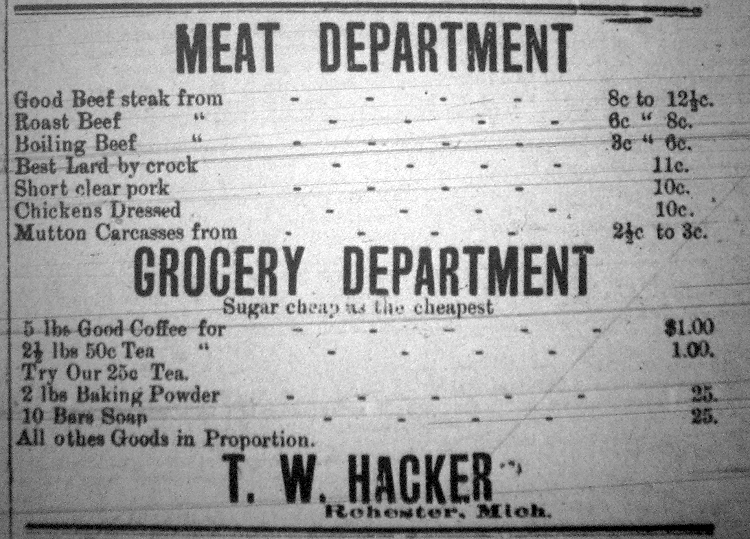
If you were shopping for groceries in Rochester 119 years ago, these are the prices you would have found at the Hacker Meat Market and grocery at 330 S. Main (now 324 S. Main, where O'Connor's Pub is located). Thomas W. Hacker established his market in Rochester in 1886, and operated it at this location for about 20 years. This ad from the Rochester Era shows Hacker's prices from 1894, when five pounds of good coffee could be had for $1.00.
Tuesday, April 16, 2013
Where Do You Think You Are - The Route
1. Start on the street corner in front of
the old Congregational Church (the old one - not the one where the congregation is currently located on North Pine St.) - This is the northwest corner of Third & Walnut, in front of Smackwater Jack's.
2. Walk a straight path due east to the place that was the
site of the first house in Oakland County and the first school in
Rochester. This takes you to the Rochester Settlement Marker located on East Third Street at the East Alley.
3. Walk straight north to the corner
where the old Village Hall and police station stood. This location is at the northeast corner of Fourth Street and East Alley, where the municipal parking lot is.
4. Walk straight west to the street corner in front
of the old 1937 post office building. This is the location of the Penny Black restaurant on the northeast corner of Fourth & Walnut.
5. Walk straight north to the next street
intersection. (Intersection of Walnut & West University Drive).Cross the street and walk straight west to the street corner in
front of the old Nichols Funeral Home stood (now the corner of West University and Oak Streets; Nichols was the predecessor of Pixley Funeral Home). Walk straight north to the
Charles W. Case house (522 Oak Street).
6. Walk about 220 feet due northeast from
the front of the Charles W. Case house. Where are you? You are at the plaza east of the police station entrance where the World War II Honor Roll and Harris Fountain are now located.
If you liked this little exercise, stay tuned, because the Rochester Avon Historical Society's downtown walking tours will soon be starting a new season. The first walk will be held on Tuesday, May 14 at 7 p.m., and you can meet host and tour guide Rod Wilson in front of the Rochester Mills Brewing Company on Fourth Street. For other tour times and dates, visit the RAHS web site or Facebook page.
Saturday, April 13, 2013
Where Do You Think You Are?
OK, history buffs and long-time Rochester residents, here's a geography quiz for you. All you have to do is follow the instructions listed below from point to point and tell me where you end up! All locations are within the municipal limits of the City of Rochester, so if you end up out on Avon Road, you to a wrong turn somewhere. Those who are up for some exercise may want to physically walk the route, but for the rest of you, this trip can probably be taken right inside your head, with or without the aid of a map. For helpful hints and information about some of the historic sites referenced in the clues, I recommend following the route on the Oakland Regional Historic Sites web site.
Ready? Here we go:
Ready? Here we go:
1. Start on the street corner in front of
the old Congregational Church (the old one - not the one where the congregation is currently located on North Pine St.)
2. Walk a straight path due east to the place that was the
site of the first house in Oakland County and the first school in
Rochester.
3. Walk straight north to the corner
where the old Village Hall and police station stood.
4. Walk straight west to the street corner in front
of the old 1937 post office building.
5. Walk straight north to the next street
intersection. Cross the street and walk straight west to the street corner in
front of the old Nichols Funeral Home stood. Walk straight north to the
Charles W. Case house.
6. Walk about 220 feet due northeast from
the front of the Charles W. Case house.
Where do you think you are?
Feel free to tell me where you ended up in the comments. I will hold all comments until Tuesday, April 16, and then I will release the comments for publication and post the answer. Enjoy!
Saturday, April 6, 2013
Pioneer Farmsteads: Albert Terry Farm
Near the southwest corner of Auburn & Livernois roads stands a beautiful brick farmhouse that dates from the Rochester area's pioneer era. The Greek Revival residence was built by settler Albert Terry about 1840 when the land on which it stands was still wilderness, and it has survived 173 years of development swirling around it.
Albert Terry was born in Livingston County, New York in 1817, the year in which the village of Rochester was founded. He was the eldest of a family of fourteen children. Terry taught school for a time as a youth, and then made a visit to Michigan in 1838. He decided to move permanently to Michigan and returned the following year, when he purchased the northeast quarter of section 33 of Avon Township and thereafter built his home. In the fall of 1839 he returned to New York to claim his bride, Delia Lathrop, and brought her back to his new home in Michigan. The Terrys had seven children. Delia Terry died in 1859, and the following year Terry married Lucina Richardson, the daughter of Isaac Richardson of Pontiac.
The farm was prosperous, and Terry added more acreage until he had a farm of 192 acres, one of the largest in the township. He grew fruit and won several agricultural awards for his apples and pears. Albert Terry was a leader in local politics and was elected to the office of Supervisor of Avon Township for 14 years, from 1862 to 1876.
Terry died in 1880; his farm was subsequently owned by Samuel Durrant and later by Georgiana Kersting.
Albert Terry was born in Livingston County, New York in 1817, the year in which the village of Rochester was founded. He was the eldest of a family of fourteen children. Terry taught school for a time as a youth, and then made a visit to Michigan in 1838. He decided to move permanently to Michigan and returned the following year, when he purchased the northeast quarter of section 33 of Avon Township and thereafter built his home. In the fall of 1839 he returned to New York to claim his bride, Delia Lathrop, and brought her back to his new home in Michigan. The Terrys had seven children. Delia Terry died in 1859, and the following year Terry married Lucina Richardson, the daughter of Isaac Richardson of Pontiac.
![]() |
| The Terry house as it looked in 1877 |
The farm was prosperous, and Terry added more acreage until he had a farm of 192 acres, one of the largest in the township. He grew fruit and won several agricultural awards for his apples and pears. Albert Terry was a leader in local politics and was elected to the office of Supervisor of Avon Township for 14 years, from 1862 to 1876.
Terry died in 1880; his farm was subsequently owned by Samuel Durrant and later by Georgiana Kersting.
Monday, April 1, 2013
This Month in Rochester History
The members of the first graduating class of Oakland University received their diplomas fifty years ago this month. Commencement was held on April 19, 1963 for 125 graduating seniors, 19 of whom were residents of the Rochester area. Beverly Donato of Auburn Hills was valedictorian of the first class to earn degrees from the new university. At the ceremony, Matilda Dodge Wilson received the institution's first ever honorary doctorate.
OU's charter class had enrolled in 1959 with 570 members, but suffered a high rate of attrition. According to the university's web site, so many students flunked their first semester at the new school that officials created a policy whereby failing grades could be "erased" from the student record if the student successfully repeated a failed course.
Half a century later, Oakland University has an enrollment of nearly 20,000 students and a first-year retention rate of better than 70%. The university boasts more than 80,000 alumni.
OU's charter class had enrolled in 1959 with 570 members, but suffered a high rate of attrition. According to the university's web site, so many students flunked their first semester at the new school that officials created a policy whereby failing grades could be "erased" from the student record if the student successfully repeated a failed course.
Half a century later, Oakland University has an enrollment of nearly 20,000 students and a first-year retention rate of better than 70%. The university boasts more than 80,000 alumni.
Subscribe to:
Posts (Atom)